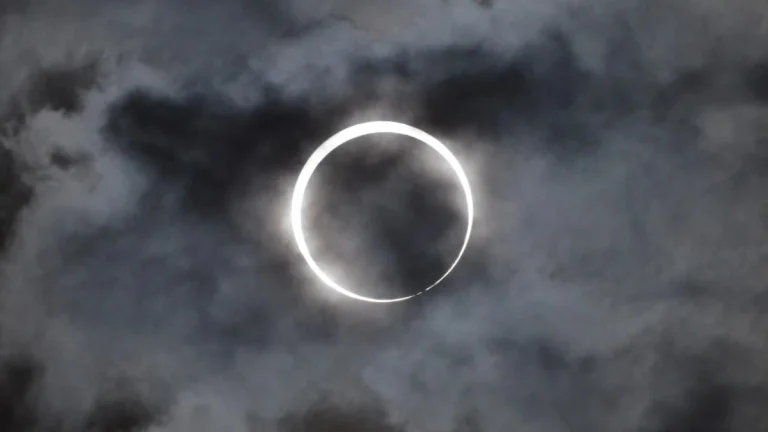
• Annular solar eclipse crosses Antarctica on February 17, 2026

    An annular solar eclipse will cross Antarctica on February 17, 2026, with the “ring of fire” phase confined to the continent and adjacent Southern Ocean waters. The event reaches its greatest eclipse at 12:11:54 UTC, when the Moon will cover 96.3% of the Sun’s diameter along the central path. A partial eclipse will be visible from southern South America, southern Africa, Madagascar, Réunion, Mauritius, and Antarctic coastal regions.
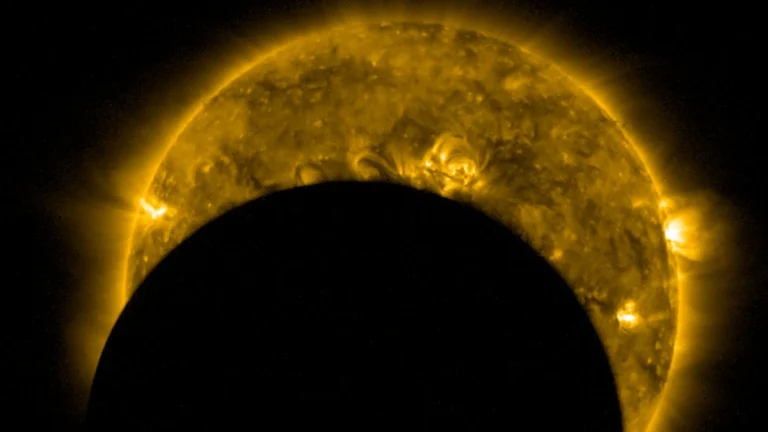
  • New research reveals bioelectrical coordination in trees during solar eclipse

    A recent study reveals that Norway spruce trees in the Italian Alps exhibited synchronized bioelectrical activity during the March 2015 solar eclipse. Using high-resolution sensors, researchers detected collective responses to the eclipse’s rapid environmental changes, indicating a potential shared signaling mechanism among trees.

  • Total solar eclipse of December 4, 2021

    A total solar eclipse will take place on December 4, 2021, just two weeks after a partial lunar eclipse on November 19 – the longest since 1440 and until 2669​.1 The total eclipse will be visible from Antarctica and partially visible from South Africa and south…

  • ‘Ring of Fire’ – Annular solar eclipse of June 10, 2021

    An annular solar eclipse of June 10, 2021, will be visible from northern Canada, Greenland, and Russia, with a partial eclipse visible from northern North America, Europe, and Asia. During the event, a bright ring will surround the moon silhouette at the peak of the…

  • Total solar eclipse of December 14, 2020

    A total solar eclipse will take place at 16:13 UTC on December 14, 2020, and be visible from the South Pacific, Chile, Argentina, and the South Atlantic. Observers from southern South America, the Pacific, and those currently in Antarctica will experience a partial…