• Gravitational anomaly in 2007 hints at rapid changes near Earth’s core

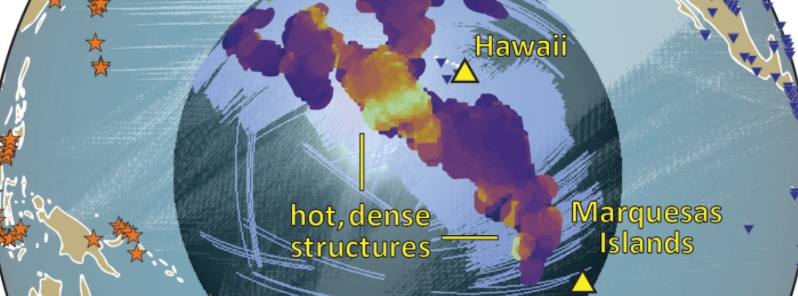
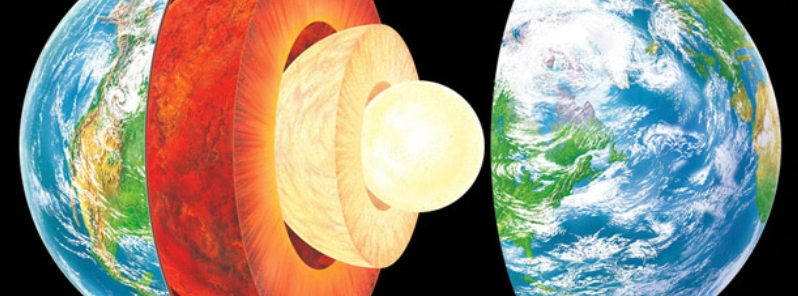
    A gravity anomaly recorded by NASA–German GRACE satellites in early 2007 over the Atlantic Ocean points to mass redistribution near Earth’s core–mantle boundary, around 2 700–2 900 km (1 700–1 800 miles) deep. Researchers suggest a perovskite-to-post-perovskite mineral phase change produced decimetric boundary shifts, offering the first evidence that deep mantle processes can unfold within just a few years and potentially affect Earth’s magnetic field.
  • Deciphering the mysteries of the Earth’s core-mantle boundary (CMB)

    Scientists from the SLAC National Accelerator Laboratory and the European Synchrotron Radiation Facility have uncovered crucial details about the Earth’s core-mantle boundary and the evolution of super-Earths. By using advanced high-energy X-ray diffraction, they found that variations in iron content in molten rock do not significantly impact its density.

  • Low-velocity seismic structure discovered in Earth’s outer core

    Two Australian scientists discovered a ‘seismic abnormality’ in the Earth’s outer core — a “donut” of energy around the equator, where seismic waves move about 2% slower than in other core regions. Their study provides new clues about the dynamics of our planet’s magnetic field.

  • Earth’s inner core slowdown confirmed by seismic data

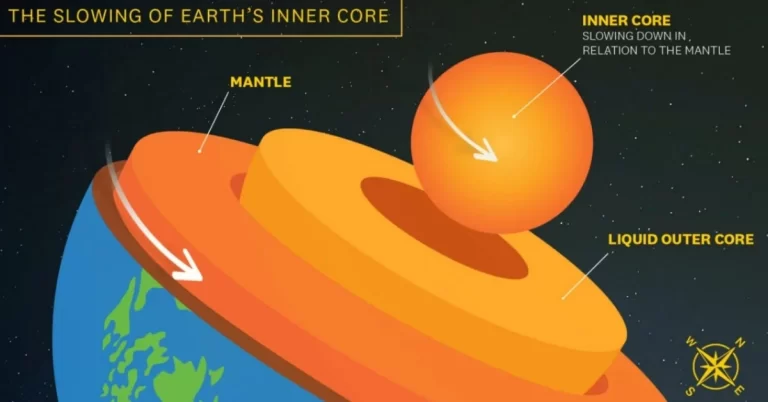
    A new scientific study proves that the Earth’s rotation speed has been decreasing throughout the past decade, with data suggesting that the rotational speed of the inner core has gotten 2.5 times slower compared to the past decade.

  • Decade of Swarm satellite data unveils new insights into Earth’s magnetic field and core dynamics

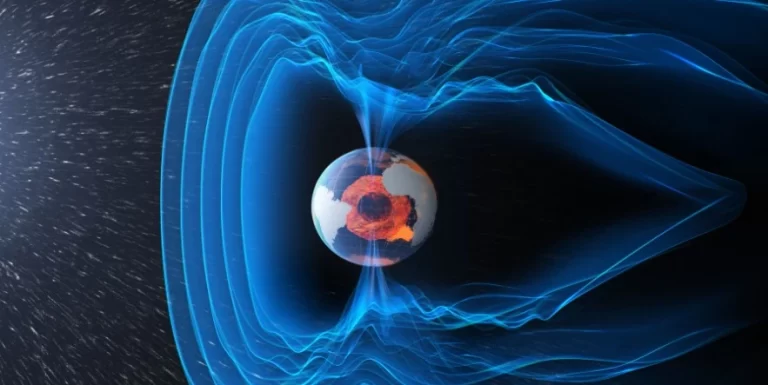
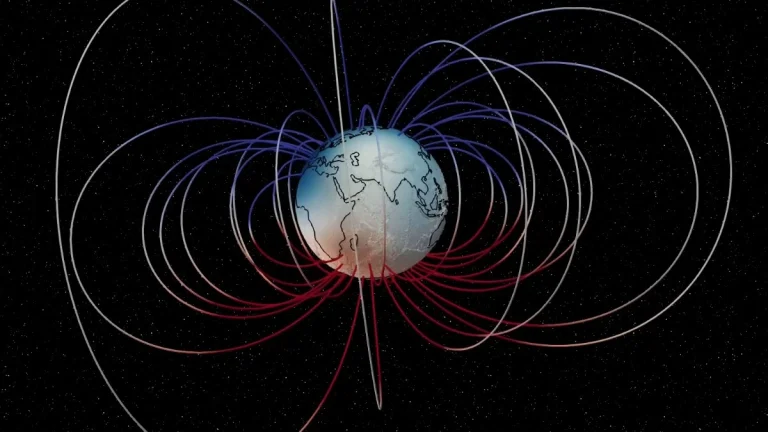
    Launched in 2013, the European Space Agency’s (ESA) Swarm mission, consisting of three satellites, has provided a decade of invaluable data on Earth’s magnetic field and core dynamics. This data has enabled significant advances in understanding the mechanisms behind the magnetic field’s slow changes, as detailed in a recent ESA-funded project report.

  • New insights reveal Earth’s inner core exhibits 8.5-year wobble

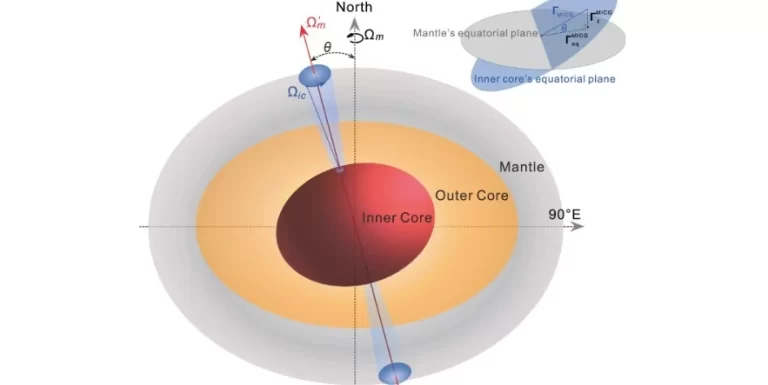
    Researchers from China have confirmed an 8.5-year Inner Core Wobble (ICW) in Earth’s polar motion and length-of-day variations, revealing a static tilt of about 0.17 degrees between the inner core and mantle, challenging long-standing assumptions about Earth’s internal dynamics.

  • Study reveals Earth’s core may be leaking helium-3

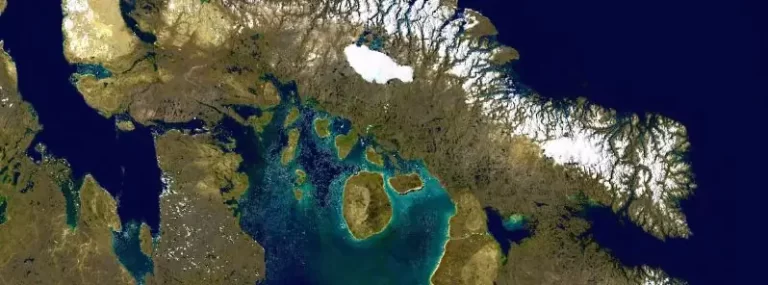
    An unprecedented discovery of elevated helium-3 to helium-4 ratios in ancient lava flows on Baffin Island, Canada, suggests that these rare isotopes may be leaking from Earth’s core. Published on October 18, 2023, the groundbreaking study led by geochemist Forrest Horton of the Woods Hole Oceanographic Institution opens new avenues for understanding Earth’s deepest regions and its formative history.