
Neptune’s moon Triton has the coldest surface ever measured in the solar system, minus 391 degrees Fahrenheit, yet Voyager 2 caught geysers on it blasting dark plumes 5 miles high
Voyager 2 found Triton’s surface at about 38 K (-235°C, -391°F) during its 1989 flyby, yet the spacecraft also photographed geyser-like eruptions driving dark material about 8 km (5 miles) above the moon and more than 100 km (62 miles) downwind. The eruption columns are direct observations; their energy source remains unresolved. A 2022 reassessment found that plume and fan locations once used to favor a sunlight-driven nitrogen-geyser model do not strongly distinguish that mechanism from alternatives powered by Triton’s internal heat.
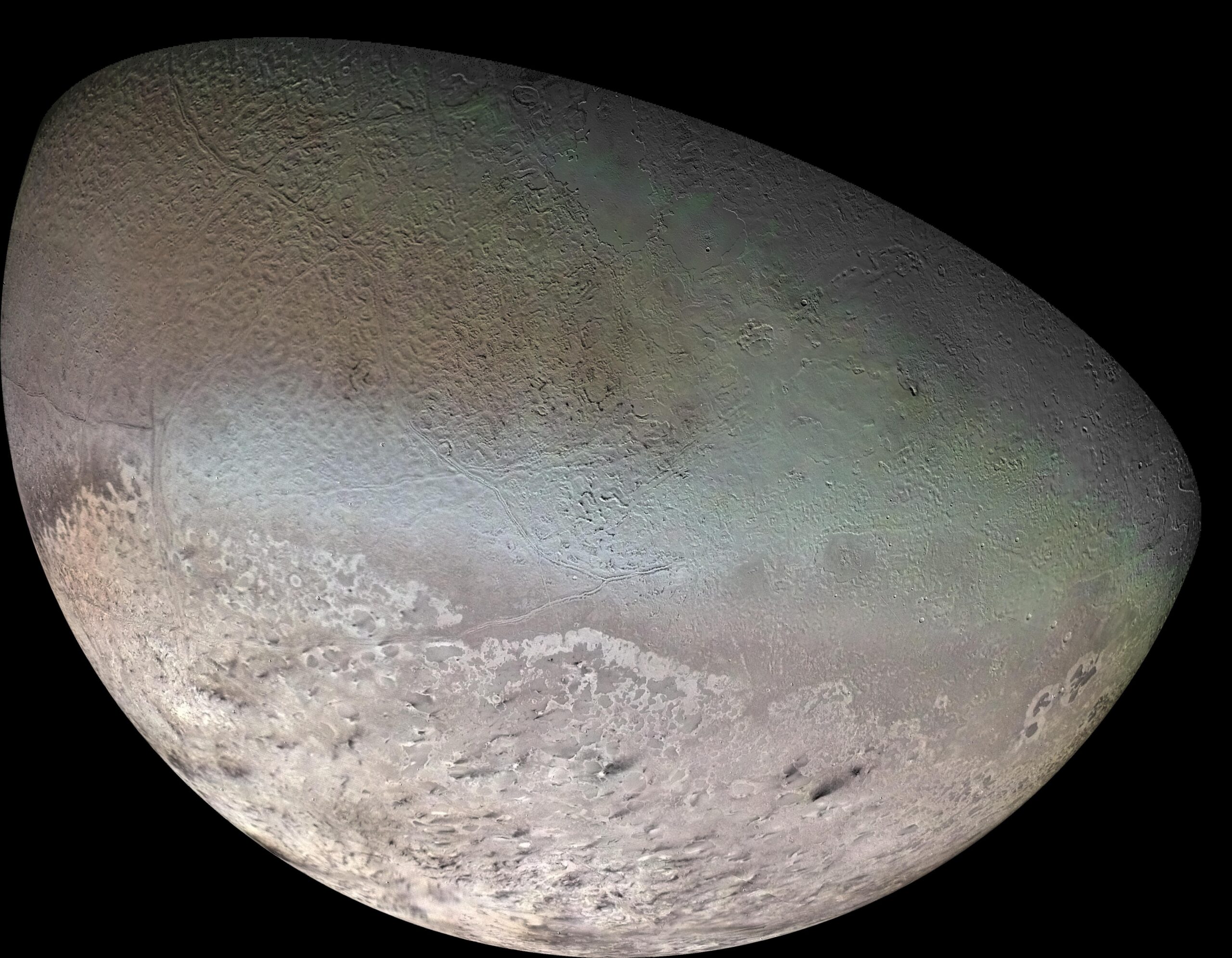
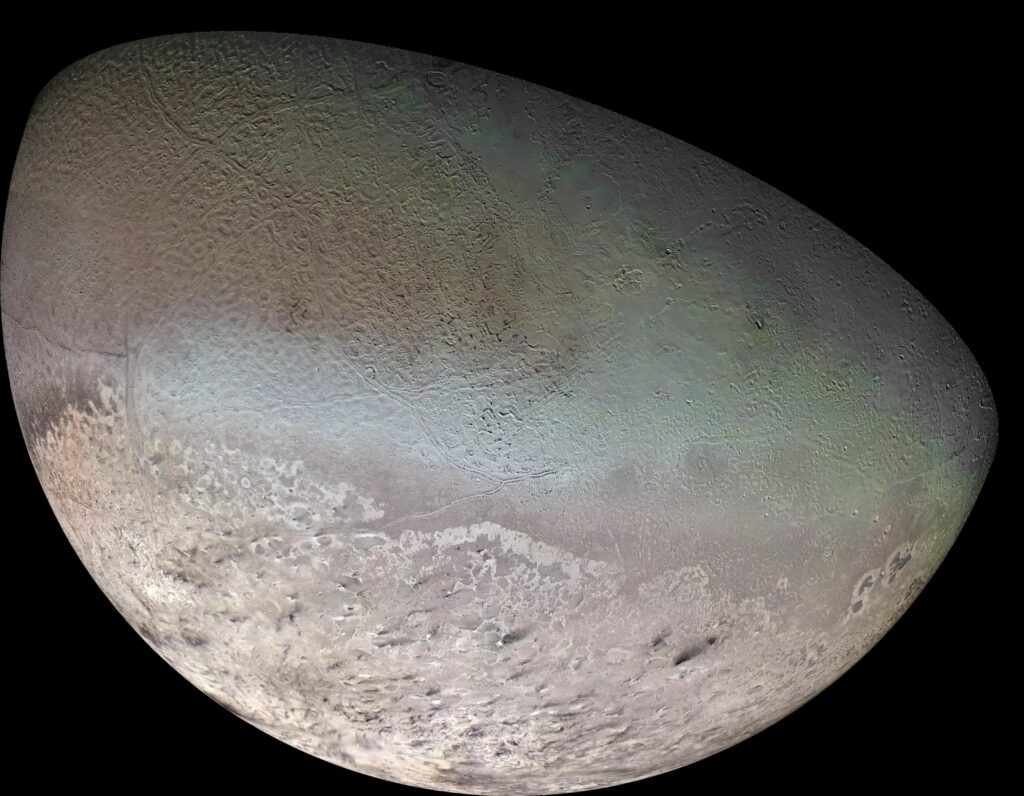
Global color mosaic of Triton assembled from Voyager 2 images acquired during the 1989 Neptune encounter. Dark streaks cross the southern terrain where plume-related deposits were identified from Voyager imagery. Credit: NASA/JPL/USGS
The plume discovery came from images taken as Voyager 2 closed in on Triton in August 1989, during the only spacecraft encounter ever conducted at Neptune’s largest moon. An image acquired on August 24 from 99 920 km (62 087 miles) away caught one narrow column almost in profile. The column climbed nearly 8 km (5 miles) before forming a dark cloud that extended about 150 km (93 miles) westward in Triton’s winds.
The temperature makes that activity difficult to explain. At about 38 K, most nitrogen at Triton’s surface is frozen, and NASA describes the moon as one of the coldest objects in the solar system. The term “geyser-like” describes the observed eruption geometry rather than an Earth-like water geyser: Voyager saw dark material rising through Triton’s thin nitrogen atmosphere from a surface dominated by volatile ices.
Soderblom et al. (1990) reported at least four active geyser-like eruptions in the Voyager 2 images. The two best documented eruptions formed columns of dark material reaching about 8 km (5 miles), where their clouds remained suspended and drifted more than 100 km (62 miles) downwind. The researchers estimated the rising columns ranged from several tens of metres across to as much as about 1 km (0.6 miles), while the ambient surface temperature around the plume environment was 38 ± 3 K.

The first physical explanations focused on solar energy rather than deep internal heat. In the solid-state greenhouse model, sunlight penetrates a translucent layer of nitrogen ice and warms material below the surface. Nitrogen then sublimates directly from solid ice into gas, pressure builds beneath the overlying layer, and the gas escapes through a vent while carrying ice and dark particles upward.
The 1990 plume analysis showed that only a small temperature difference was required within that model. Soderblom and colleagues calculated that warming nitrogen ice by less than 4 K above the surrounding 38 ± 3 K surface could produce enough pressure to drive material to the observed 8 km (5 mile) altitude. That calculation demonstrated that the solar mechanism was physically capable of producing a plume; it did not establish that sunlight was the actual energy source for every observed eruption.
Part of the apparent disagreement in later descriptions comes from what counts as a confirmed plume. The discovery paper reported at least four active geyser-like eruptions, while Hofgartner et al. (2022) applied a stricter observational criterion and treated only two as confirmed because those two clouds had visible columns connecting them to Triton’s surface. The confirmed plumes are known as Mahilani and Hili.

Voyager also recorded nearly a dozen additional clouds with varying resemblance to the clouds trailing the confirmed plumes, together with approximately 120 relatively dark fan-shaped streaks on the surface. Many of the fans have been interpreted as deposits from previous eruptions, but that connection has not been directly demonstrated. The two confirmed plume clouds trailed westward, while many surface fans point generally toward the northeast, a difference that can be reconciled with winds changing direction with altitude but does not establish how the fans formed.
Those uncertain relationships became important because plume and fan locations were among the principal arguments for the solar-powered model. The confirmed plumes occurred relatively close to the subsolar latitude during the Voyager encounter, where solar heating was strongest, while the broad distribution of dark fans was interpreted as a record of seasonal eruptions. For decades, that geometry helped make the solid-state greenhouse explanation the leading hypothesis.
Hofgartner et al. re-examined that evidence using the geographic distribution of the confirmed plumes, candidate clouds and dark fans. Their 2022 analysis found that neither the plume locations nor the fan distribution provides strong evidence in favor of the solar-powered mechanism. The authors concluded that all three plausible eruptive hypotheses should remain under consideration rather than treating the solid-state greenhouse model as the default explanation.

One hypothesis retains the original solar-driven nitrogen-geyser mechanism. The other two obtain their energy from Triton’s interior: outgassing associated with the icy mantle, and melting at the base of a permanent nitrogen-rich polar cap. Distinguishing among them matters because they describe different physical connections between Triton’s surface volatiles and its deeper interior. A shallow solar-powered eruption would not carry the same implications for internal activity as a plume sustained by heat coming from below.
The 2022 study proposed five observational tests for a future spacecraft. Researchers would need to determine the composition and thickness of Triton’s southern terrains, measure the composition of the dark fan deposits, map where active plumes occur, map the wider distribution of fans, and measure surface temperatures at plume or fan locations. The authors concluded that the tests are complementary but could be performed during a single sufficiently capable flyby.
Triton’s seasons also make the timing of another close observation scientifically important. Hofgartner et al. calculated that, if sunlight is responsible for the eruptions, the 2030s and 2040s could provide the last favorable opportunity for roughly a century to observe actively erupting plumes under comparable seasonal conditions. That timing is conditional on the solar-driven model being correct; an internally powered mechanism would not be governed by the same illumination requirement.
No spacecraft has returned to Triton since Voyager 2. The existing plume record therefore comes from a short interval during a single 1989 encounter, leaving their composition, recurrence, distribution and energy source unresolved. A future spacecraft able to detect active plumes, measure their composition and temperature, and map the surrounding deposits could test whether Voyager saw a shallow seasonal nitrogen process or evidence of energy moving outward from Triton’s interior.
References:
1 Soderblom, L. A., Kieffer, S. W., Becker, T. L., Brown, R. H., Cook, A. F., II, Hansen, C. J., Johnson, T. V., Kirk, R. L., & Shoemaker, E. M. (1990). Triton’s geyser-like plumes: Discovery and basic characterization. Science, 250(4979), 410–415. DOI: 10.1126/science.250.4979.410
2 Hofgartner, J. D., Birch, S. P. D., Castillo, J., Grundy, W. M., Hansen, C. J., Hayes, A. G., Howett, C. J. A., Hurford, T. A., Martin, E. S., Mitchell, K. L., Nordheim, T. A., Poston, M. J., Prockter, L. M., Quick, L. C., Schenk, P., Schindhelm, R. N., & Umurhan, O. M. (2022). Hypotheses for Triton’s plumes: New analyses and future remote sensing tests. Icarus, 375, 114835. DOI: 10.1016/j.icarus.2021.114835
3 Triton – NASA Science – page last updated November 3, 2024

I’m a science journalist and researcher at The Watchers, contributing to the Epicenter edition, where I cover peer-reviewed scientific research and emerging discoveries across Earth and space sciences. With a background in astronomy and a passion for environmental science, I’ve worked in shark and coral conservation in Fiji, conducting reef and shark-behavior research, contributing to mangrove restoration, and earning PADI Open Water and Coral Reef Certifications. I bring a blend of scientific rigor and storytelling to illuminate the discoveries shaping our planet and beyond.
Published in the last 24 hours
- When the Sun’s stormy peak dragged NASA's 77-tonne Skylab out of orbit earlier than expected in 1979, debris rained across Western Australia and the town of Esperance fined NASA $400 for littering; a California radio host finally paid it 30 years later Epicenter
- A rose-colored rock found in the Sahara in 2022 turned out to be a piece of Mars more than 4.1 billion years old Epicenter
- Flying glass cut a teacher in Russia but none of her 44 pupils, because when a meteor flashed across the sky in 2013, she told them to get under their desks Epicenter
- Marine iguanas in the Galápagos got shorter by as much as 6.8 cm (2.7 inches), or a fifth of their length, when El Niño left them short of the seaweed they can digest, and the biggest ones shrank the most and lived the longest Epicenter
