
Mysterious fast radio bursts may originate from asteroid collisions with neutron stars
Fast radio bursts (FRBs) might originate from collisions between asteroids and neutron stars, researchers from the University of Toronto, the University of Oxford, and the University of Canterbury announced on November 15, 2024.
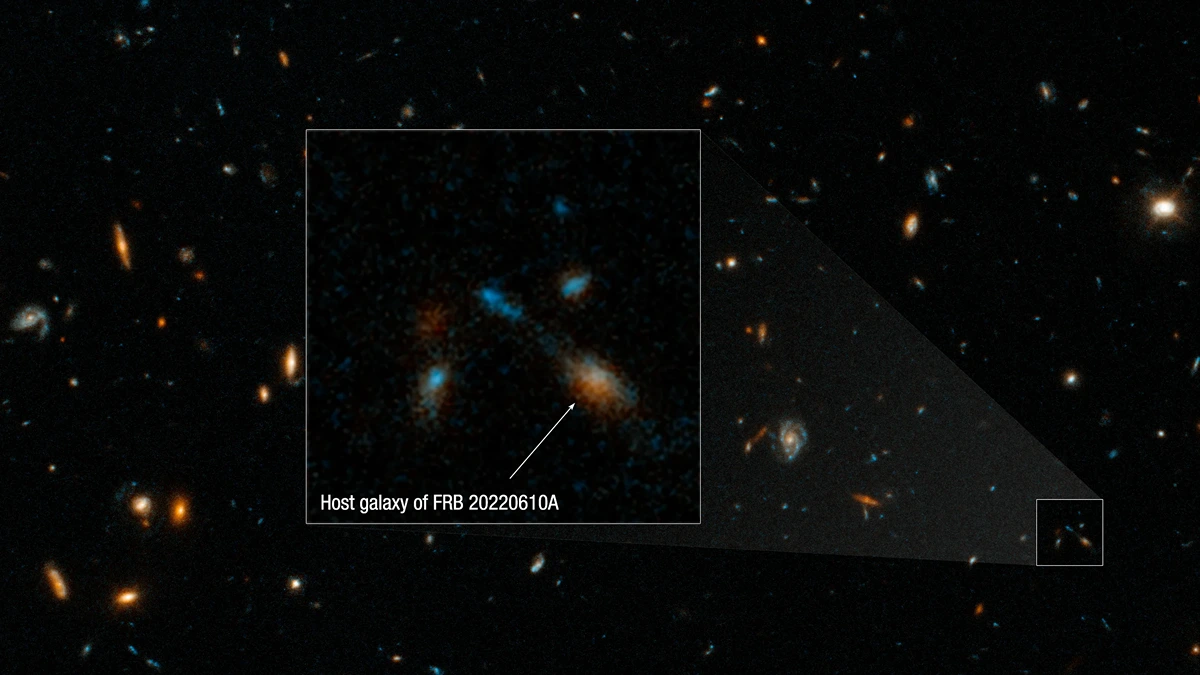
A NASA Hubble Space Telescope image of the host galaxy of an exceptionally powerful fast radio burst, FRB 20220610A. Image credit: NASA, ESA, STScI, Alexa Gordon (Northwestern)
Researchers proposed a hypothesis that FRBs could stem from collisions between asteroids and neutron stars, some of the universe’s densest objects.
FRBs are sudden, high-energy pulses of radio waves that have puzzled scientists since their discovery in 2007. The millisecond-scale emissions can release energy equivalent to the Sun’s output over several days.
The high-energy phenomena release immense energy comparable to humanity’s global energy usage for 100 million years.
“FRBs so far defy explanation, with over 50 potential hypotheses of where they come from—we counted!” said Dr. Dang Pham, a lead scientist at the University of Toronto.
The team’s research connects FRBs to interstellar objects (ISOs) like asteroids and comets, which could collide with neutron stars at a frequency sufficient for observed FRB rates.
What are neutron stars?
Neutron stars are remnants of massive stars that collapsed under their gravity after a supernova explosion. Despite their relatively small size of about 20 km (12 miles) in diameter, these stars can have masses greater than the Sun.
The stars have an incredible density (a teaspoon would weigh approximately 10 million tons) and result in extreme gravitational and magnetic forces.
“Neutron stars are extreme places, with over the mass of the Sun squeezed into a sphere about 12 miles [20 km] across, giving them some of the strongest gravitational and magnetic fields in the universe. This means that a huge amount of potential energy is released when an asteroid or comet drops onto one, in the form of a flash of radio waves bright enough to be seen across the universe,” Dr. Matthew Hopkins from the University of Oxford explained the energy released during such collisions.
How asteroids could trigger FRBs?
When an asteroid or interstellar object is drawn into the intense gravitational field of a neutron star, it accelerates to nearly the speed of light. Upon impact, the asteroid vaporizes, generating a plasma ball that interacts with the neutron star’s magnetic field. The interaction produces a focused beam of radio waves, potentially observed as an FRB.
According to the research, an asteroid measuring approximately 1 km (0.62 miles) in diameter collided with a neutron star with a magnetic field trillions of times stronger than Earth’s and could release around 1029 Joules of energy.
“This is a huge number, about one hundred million times all the energy used by all of humanity over a year,” Dr. Hopkins elaborated.
Collision frequency matches observed FRBs
Interstellar objects are abundant, with an estimated 1027 such bodies in the Milky Way galaxy alone.
The team calculated that while individual collisions between a neutron star and an asteroid are rare (occurring approximately once every 10 million years per neutron star), the vast number of neutron stars and galaxies align with observed FRB rates.
“We have shown that interstellar objects, an understudied class of asteroids and comets thought to be present between stars in galaxies throughout the universe, could be numerous enough that their impacts with neutron stars could explain FRBs,” said Dr. Pham.
Challenges with repeating FRBs
FRBs can be categorized into one-off and repeating types. The model explains single-occurrence FRBs while struggling to account for repeating bursts observed from the same source. Repeating FRBs can occur as frequently as twice per hour, suggesting a different mechanism.
“We find that this model cannot account for repeating FRBs because a neutron star colliding with an interstellar rock is a rare, random event,” Dr. Hopkins addressed this limitation.
Previous research has proposed that repeating FRBs might originate from neutron stars interacting with dense asteroid belts, similar to the one between Mars and Jupiter in our solar system. The hypothesis requires further investigation.
Implications for the evolution of FRBs
The team’s findings suggest that the rate of FRBs may increase over the universe’s lifetime. As neutron stars and interstellar objects accumulate over cosmic time, collisions should become more frequent.
“If this model is true, then we should observe FRB rates increase as the universe ages. This remains an open research question that could benefit from more observations,” Dr. Pham noted.
Future observations and open questions
The study shows the importance of further observations in understanding the origins of FRBs.
Researchers hope to determine which galaxies are most associated with these bursts by tracing FRBs to their host galaxies and studying their energy signatures. The team also plans to explore the potential role of binary interstellar objects in producing FRBs with sub-bursts.
“Understanding the evolution of FRB rates over cosmic time can also help us understand more about this model. More FRB observations could also place more constraints on how energetic these events are, which will inform us about how FRBs are emitted,” Dr. Pham added.
Projects like the Canadian Hydrogen Intensity Mapping Experiment (CHIME), the Canadian Hydrogen Observatory and Radio-transient Detector (CHORD), and the Australian Square Kilometre Array Pathfinder (ASKAP) are expected to play main roles in advancing this field.
The research conducted by teams from institutions including the University of Toronto and the University of Oxford represents a main step in understanding fast radio bursts.
Scientists are gaining a deeper understanding of the energetic processes shaping our universe by connecting these powerful emissions to collisions between neutron stars and interstellar objects.
“Additional works to constrain how populated galaxies are with interstellar objects will also give us better information on how often neutron stars can collide with these objects in the universe,” Dr. Pham concluded.
References:
1 Fast Radio Bursts and Interstellar Objects, Dang Pham, Matthew J. Hopkins, Chris Lintott, Michele T. Bannister, Hanno Rein – Cornell University – November 15, 2024 – https://doi.org/10.48550/arXiv.2411.09135 – OPEN ACCESS

Rishika holds a Master’s in International Studies from Stella Maris College, Chennai, India, where she earned a gold medal, and an MCA from the University of Mysore, Karnataka, India. Previously, she served as a Research Assistant at the National Institute of Advanced Studies, Indian Institute of Science, Bengaluru, India. During her tenure, she contributed as a Junior Writer for Europe Monitor on the Global Politics website and as an Assistant Editor for The World This Week. Her work has also been published in The Hindu newspaper, showing her expertise in global affairs. Rishika is also a recipient of the Women Empowerment Award at the district level in Haryana, India, in 2022.

I believe the energy in joules quoted may be a typo.
“….1029 Joules of energy….” is not a vast amount.
Wondering if it was meant to say 10^29 Joules because this would relate nearer to the energies discussed.