
A rose-colored rock found in the Sahara in 2022 turned out to be a piece of Mars more than 4.1 billion years old
A rose-colored meteorite discovered in Mali’s Sahara Desert in 2022 contains rock that formed on Mars more than 4.1 billion years ago, according to research published on October 29, 2026. Known as Teghaza 001, the specimen preserves evidence of an ancient crust formed from cooling magma and subsequently altered by water, offering a rare direct record of the planet’s earliest geological history.
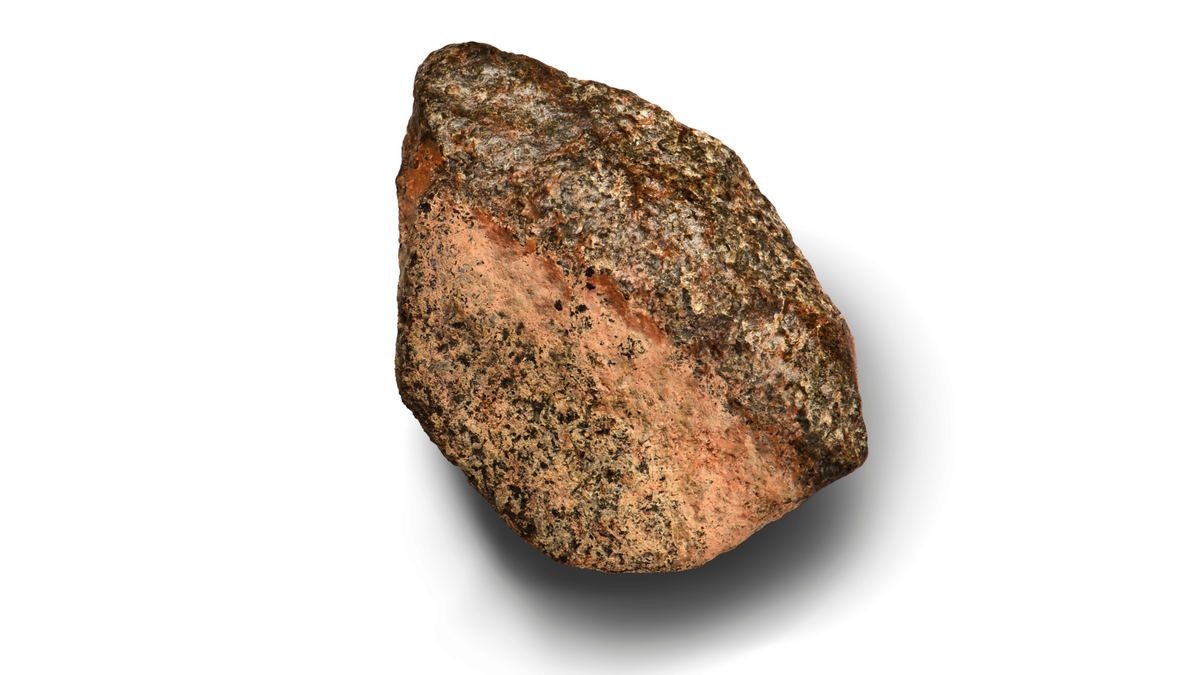
Called Teghaza 001, this rose-colored rock is one of the most ancient Martian meteorites ever found on Earth. Credit: Credit: Darryl Pitt / Maine Mineral & Gem Museum
Teghaza 001 was recovered by Sahrawi meteorite hunters during an expedition in northern Mali in early September 2022. The official Meteoritical Bulletin records eight stones with a combined mass of 799 g (1.76 lb), rather than a single intact meteorite of that weight. The largest recovered stone weighed 442 g (15.6 oz). The discovery site lies north of the archaeological area of Taghaza, in the Sahara Desert.
The importance of the find became clear only after researchers examined its minerals in detail. Most Martian meteorites available to laboratories are considerably younger than the ancient terrain covering much of Mars. Teghaza 001 offers something different: a physical sample of the planet’s earliest crust, with chemical evidence of how that crust formed and interacted with water billions of years before the rock reached Earth.
A Sahara discovery that almost escaped closer examination
Researchers at the University of New Mexico initially examined the meteorite’s mineral composition and oxygen isotopes, which provide clues to the planetary body where a rock originated. Its chemistry matched other Martian meteorites, and it received the official classification of a shergottite, the most common major class of Martian meteorites. The Meteoritical Society approved the name Teghaza 001 in April 2024, with the classification appearing in Meteoritical Bulletin No. 113 in 2025.
That classification initially made the specimen seem less promising to Yang Liu, a planetary scientist at NASA’s Jet Propulsion Laboratory (JPL). Shergottites have been studied extensively, and many formed much later in Martian history. Liu nevertheless examined the sample and noticed textures and minerals that were unusual for the group.
One discovery proved particularly important: zircon crystals. Zircon can retain traces of radioactive elements that change into other elements at predictable rates, allowing researchers to estimate the timing of ancient geological events.
“It was only after we started looking closely that we realized this meteorite is really unique,” Liu said in NASA’s October 29, 2026 announcement.
The identification led to a broader collaboration involving JPL, the California Institute of Technology, the University of California, Los Angeles, the University of Maine and the University of New Mexico. Their findings were published in Science on October 29, 2026. A companion study of the meteorite’s water-related chemistry had appeared in Science Advances on June 10, 2026.
Three mineral clocks establish an age exceeding 4.1 billion years
Credit: NASA/JPL-Caltech
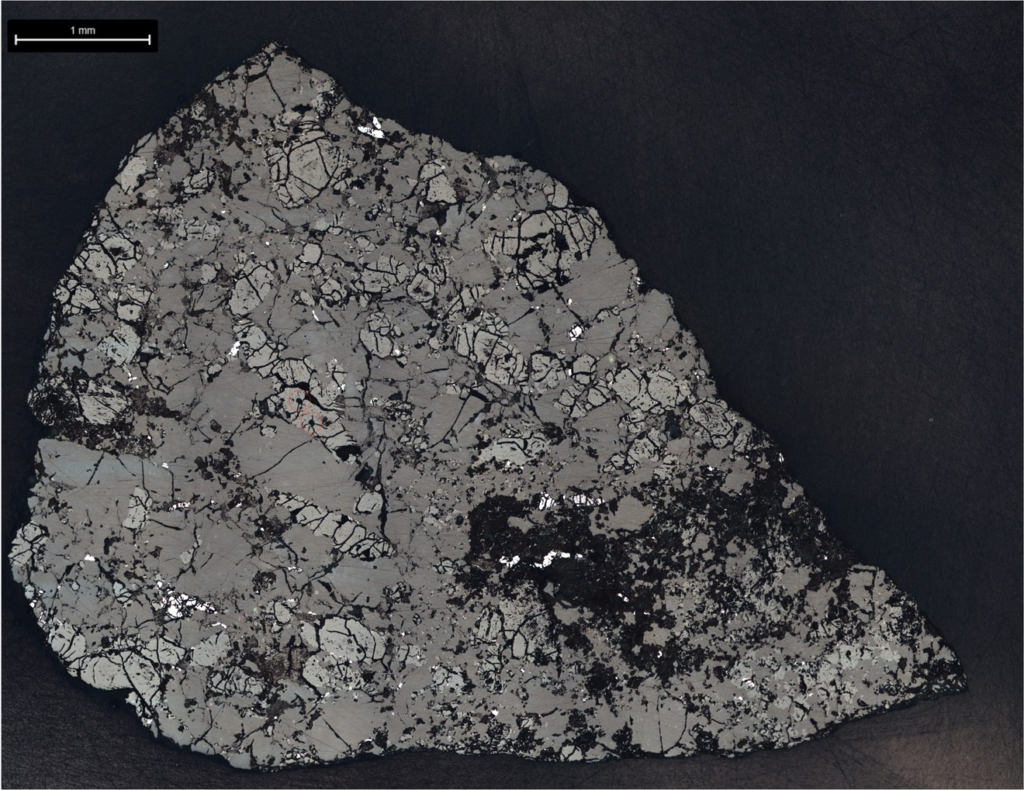
Determining the age of Teghaza 001 required separating the rock’s original formation from geological events that later changed its minerals. Researchers used several radioactive dating systems, including uranium-lead measurements in zircon, lead-isotope measurements in apatite, and rubidium-strontium dating of silicate minerals.
The zircon measurements produced a weighted age of approximately 4.111 billion years, with a reported uncertainty of 13 million years. Apatite crystals yielded a comparable weighted age of approximately 4.124 billion years, with an uncertainty of 28 million years. A rubidium-strontium analysis gave about 4.238 billion years, although its uncertainty was considerably larger. The ages overlap within their reported uncertainties.
François Tissot of Caltech helped apply an in-situ rubidium-strontium technique that measures individual mineral grains without dissolving the entire sample. The analysis used a fragment smaller than a fingernail. Preserving material is particularly valuable when scientists have only a limited quantity of an ancient meteorite available for testing.
There is an important qualification to the age. Geological clocks can sometimes be reset when rocks experience heat or chemically active fluids. The researchers found evidence that Teghaza 001 underwent significant alteration on Mars, potentially affecting several dating systems. Consequently, the approximately 4.1-billion-year measurements may record an alteration event rather than the exact moment the original magma crystallized.
The rock may therefore have formed earlier than the measured dates suggest. The defensible conclusion is that Teghaza 001 is at least 4.1 billion years old, not that its formation occurred precisely 4.1 billion years ago. This age also does not identify when an impact ejected the rock from Mars or when it arrived on Earth.
An unusual rock reveals a missing part of the early Martian crust
Teghaza 001 is an igneous rock, meaning its original minerals crystallized from molten material. The researchers describe it as a slowly cooled, plagioclase-rich gabbroic diorite. In simple terms, the rock formed as magma cooled and solidified rather than accumulating as loose sediment.
Its mineral composition is unusual among Martian meteorites. The official classification describes approximately 50% pyroxene, a group of silicate minerals common in igneous rocks, and 40% maskelynite, a glass-like material produced when plagioclase feldspar experiences intense shock. The rock also contains smaller quantities of other minerals, including zircon and silica-bearing phases.
The chemical differences matter because they reveal information about the material from which the magma originated. The Science study concludes that Teghaza 001 formed from a geochemically distinct mantle source that retained characteristics of Mars’s early differentiation, when the young planet separated into its core, mantle and crust.
Researchers also found evidence of a more silicon-rich and chemically diverse early crust than the familiar basalt-dominated picture suggested by many Martian meteorites. Some aspects of the rock resemble more silica-rich igneous materials, including compositions associated with granite on Earth. That comparison does not mean Teghaza 001 itself is granite, or that Mars developed an Earth-like system of moving tectonic plates.
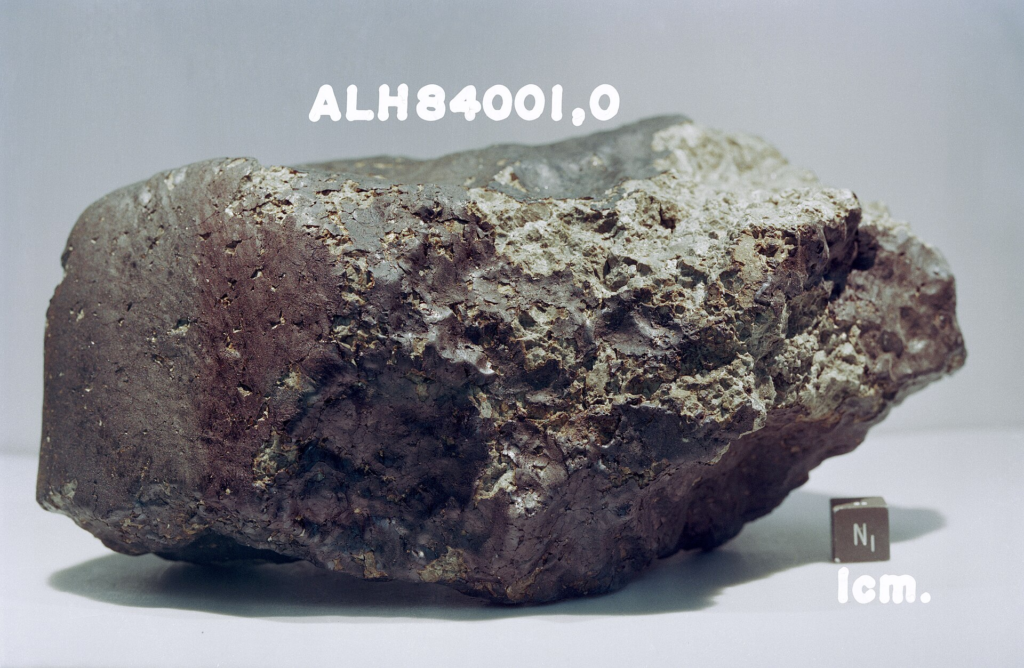
Another ancient Martian meteorite, Allan Hills 84001 (ALH84001), also preserves early crustal material. Teghaza 001 differs because its varied igneous minerals provide additional clues about the conditions in which its parent magma formed and changed. The meteorite known as Black Beauty, Northwest Africa 7034, contains fragments of ancient Martian material but represents a different kind of geological archive.
Earlier research involving Black Beauty showed how Martian meteorites can preserve evidence about water and the young planet’s geological development. Teghaza 001 adds a previously unavailable type of ancient crustal sample to that investigation.
Water changed the rock while early Mars was losing hydrogen
The meteorite’s age is only one part of its scientific value. Its minerals also preserve evidence of chemical reactions involving water, giving researchers a way to study how fluids moved through the ancient Martian crust.
Scientists examined altered mineral grains and measured different isotopes of oxygen. Isotopes are forms of the same element that have different masses. The rock contains evidence of interaction with fluids enriched in the heavier oxygen-18 isotope, consistent with chemical alteration before the meteorite was ejected from Mars.2
The companion Science Advances study investigated a different isotope system: ordinary hydrogen and deuterium, its heavier form. Researchers measured water-related hydrogen preserved in apatite, a phosphate mineral that can incorporate small quantities of water into its crystal structure.
The relative abundance of deuterium is useful because lighter hydrogen escapes into space more readily. As hydrogen is progressively lost from a planetary atmosphere, the remaining reservoir can become enriched in deuterium. This produces a chemical signature that minerals may preserve even after the surface environment has changed.
The researchers found that Teghaza 001’s apatite records mixing between hydrogen associated with magma and a heavier-hydrogen-rich component linked to the ancient Martian water system. Their modeling indicates that the latter reservoir had a deuterium-to-hydrogen ratio substantially above that of Earth’s seawater by approximately 4.1 billion years ago. The study interprets this as evidence that considerable hydrogen escape had already occurred early in Martian history.
This does not establish the exact quantity of water that Mars once possessed, the extent of any ancient ocean or the precise date when the planet became colder and drier. The isotope interpretation also depends on how different water reservoirs mixed and exchanged material with the crust.
The timing of Mars’s atmospheric evolution remains an active research question. For example, other studies have suggested that the planet’s global magnetic field may have persisted longer than previously assumed. Teghaza 001 supplies an early chemical constraint on water loss, but it does not independently establish when the magnetic field disappeared.
Thirteen possible source regions, but no confirmed Martian birthplace
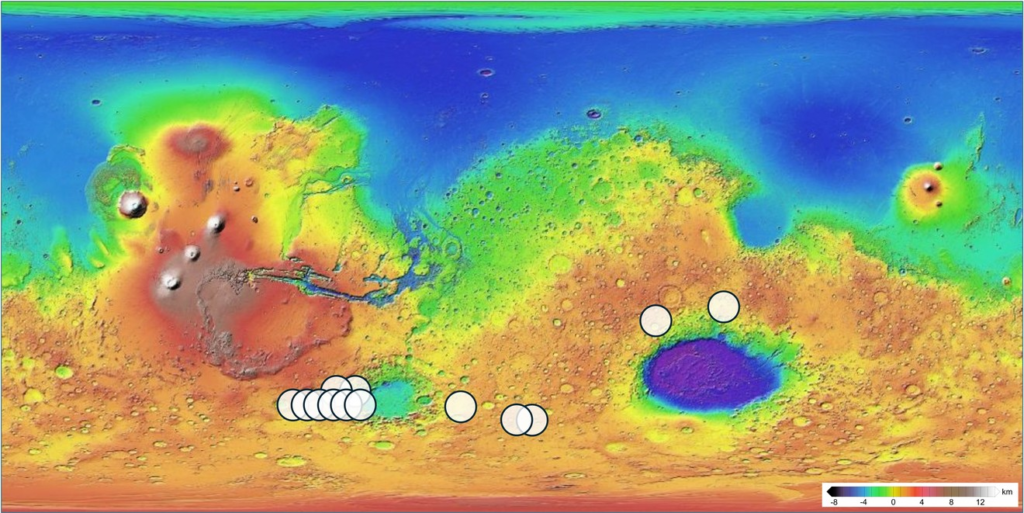
Identifying the meteorite’s original location on Mars presents another challenge. A large impact must have launched the rock into space, after which it eventually followed an orbit that brought it to Earth. Its mineral composition survives, but the journey does not preserve a geographical label.
Researchers compared the meteorite’s chemistry and mineralogy with observations made by NASA’s Mars Reconnaissance Orbiter. Their analysis identified 13 possible source areas whose characteristics resemble those of Teghaza 001, including locations associated with the ancient southern highlands.
These are geological matches, not confirmed impact sites. Similar minerals can occur in more than one region, and the available orbital measurements do not establish which candidate produced the meteorite. Additional geological evidence would be needed to narrow its origin.
The uncertainty is important because knowing the original terrain would connect the laboratory measurements to a specific part of Martian history. It could help researchers determine whether the unusual crustal composition represents a local geological environment or a more widespread component of early Mars.
Why a small ancient sample could change future Mars research
The Maine Mineral & Gem Museum in Bethel, Maine, now holds the meteorite’s main mass and most of its known pieces. The museum has made material available to scientists investigating its mineralogy, formation history, and interaction with water. Its scientific value depends not only on rarity but also on retaining enough material for independent laboratories to test new interpretations.
Teghaza 001 also provides a point of comparison for observations made directly on Mars. Rovers and orbiters can examine ancient landscapes in their geological setting, while meteorite laboratories can measure individual minerals and isotopes with a level of precision that remains difficult to achieve remotely.
Combining those approaches may help researchers connect the planet’s early mantle chemistry, crust formation and water history. A central question is whether the geological processes recorded in Teghaza 001 were common across ancient Mars or belonged to a distinctive region that spacecraft have not yet sampled.
The answer will require comparisons with other ancient rocks, improved orbital observations and, ultimately, more samples with well-established geological origins. Teghaza 001 provides a rare starting point: a dated piece of the early Martian crust whose minerals preserve traces of both its original formation and the water that subsequently altered it.
References:
1 Teghaza 001: Official meteorite classification and discovery record – Meteoritical Bulletin Database – Meteoritical Bulletin No. 113, 2025.
2 Liu, Y., et al. A Martian meteorite that formed ≳4.1 billion years ago samples Mars’ early crust and mantle – Science – October 29, 2026. DOI: 10.1126/science.adz5646.
3 NASA-funded Study Details One of Oldest Mars Meteorites Ever Found – NASA Jet Propulsion Laboratory – October 29, 2026.
4 Saper, L., et al. A Noachian hydrosphere component in the 4.1-Ga Martian meteorite Teghaza 001 – Science Advances – June 10, 2026. DOI: 10.1126/sciadv.aea3420.
5 Rare Martian Meteorite Owned by Maine Mineral & Gem Museum May Be the Oldest Ever Identified – Maine Mineral & Gem Museum – October 14, 2026.

Rishav Kothari is Editor-in-Chief of The Watchers, where he runs the newsroom and covers earthquakes, volcanoes, severe weather and space weather.
Published in the last 24 hours
- Flying glass cut a teacher in Russia but none of her 44 pupils, because when a meteor flashed across the sky in 2013, she told them to get under their desks Epicenter
- In 2017, El Niño rains turned part of Peru's Sechura Desert into a lake more than four times the size of Lake Tahoe, and families went out on wooden rafts to fish it Epicenter
- Northern lights are possible at high latitudes on November 17 and 18 as NOAA forecasts minor (G1) geomagnetic storms from coronal hole wind
- In February 2022, SpaceX launched 49 Starlink satellites into a solar storm so mild that forecasters rated it minor, and within days 38 of them had fallen back and burned up, because the storm had swollen the thin air they were flying through Epicenter
