
3D simulations reveal how a nuclear burst could break apart a threatening asteroid
Three-dimensional simulations developed at Lawrence Livermore National Laboratory show how X-rays from a nuclear standoff burst can drive extensive damage and opposing material motion through a modeled asteroid. Two of three scenarios approached the regime associated with robust disruption, but the calculations ended before researchers could determine whether the resulting fragment field would meet the criteria for a successful disruption.
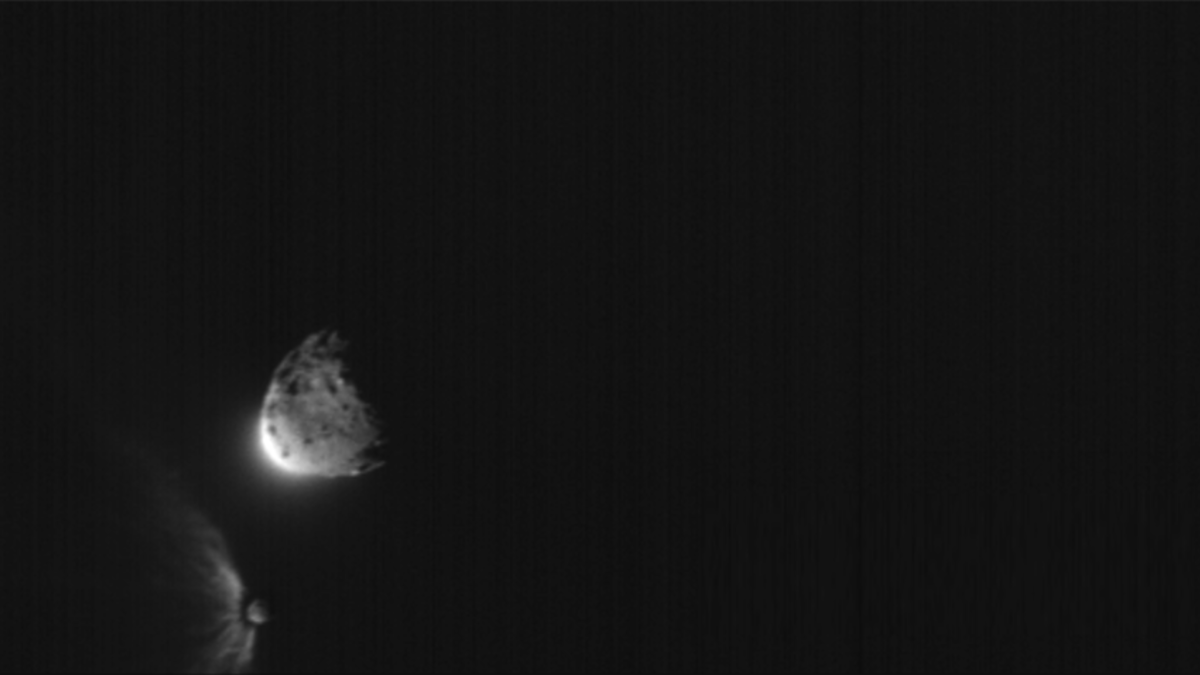
ASI’s LICIACube satellite acquired this image just after its closest approach to the Dimorphos asteroid, after the Double Asteroid Redirect Test, or DART mission, made impact on Sep. 26, 2022. In this image, it is possible to observe the Didymos and Dimorphos from a different perspective, which can be useful to determine the shapes of the asteroids. Credit: ASI/NASA
The work addresses a difficult gap in planetary-defense modeling: scientists can estimate how nuclear energy couples to an asteroid, but determining whether that energy actually breaks a complex body apart requires following fractures and material motion in three dimensions. Santistevan et al. (2026) used Lawrence Livermore National Laboratory’s Spheral code to model that process and test scenarios close to the threshold where disruption becomes possible. The result is not a demonstration that a nuclear device would reliably eliminate an asteroid threat; it is a more detailed way to calculate how such an intervention begins to damage and disperse one.
The study modeled an irregularly shaped asteroid with a spherical-equivalent diameter of about 160 m (525 feet), represented as a monolithic body of forsterite with uniform density and porosity. Researchers exposed it to the modeled X-ray output of a 1 Mt nuclear explosive device detonated above the surface, testing heights of burst of 10 m (33 feet) and 25 m (82 feet) together with different assumptions about how readily the material fractures. These were hypothetical planetary-defense calculations, not simulations of an asteroid currently threatening Earth.
In a standoff scenario, the explosive device does not strike or enter the asteroid. X-rays released by the burst deposit energy in a thin layer near the surface, rapidly heating and vaporizing material. As that material expands away from the body, it carries momentum with it and pushes on the asteroid in the opposite direction. At higher deposited energies, the response goes beyond surface ablation: a shock propagates into the body, damage accumulates internally, and the asteroid can begin to fracture.
That distinction separates nuclear deflection from nuclear disruption. Deflection aims to change an asteroid’s velocity enough for it to miss Earth while leaving most of the body intact. Disruption instead attempts to fragment and disperse the object. The latter presents a harder modeling problem because breaking a body apart is not sufficient by itself; the fragments must also separate in a way that avoids leaving large pieces capable of remaining hazardous.
Before using Spheral for the disruption calculations, the researchers tested whether it reproduced results from established mesh-based models. A suite of 1 555 one-dimensional Spheral simulations covered different X-ray fluences, asteroid materials, porosities, illumination angles, source temperatures and pulse durations. Across those calculations, Spheral agreed with the earlier models to within 0.8%. Full three-dimensional calculations agreed with previous cylindrical simulations to within about 18.1%, with the paper identifying coarser practical resolution in 3D as an important limitation.
The three-dimensional disruption runs then exposed the modeled 160 m (525 feet) asteroid to conditions near the boundary where previous mission-design approximations did not guarantee robust disruption. In two of the three cases, damage spread extensively through the body while large amounts of material developed motion in opposite directions. The authors interpreted that combination as evidence that the modeled asteroids were actively disrupting.
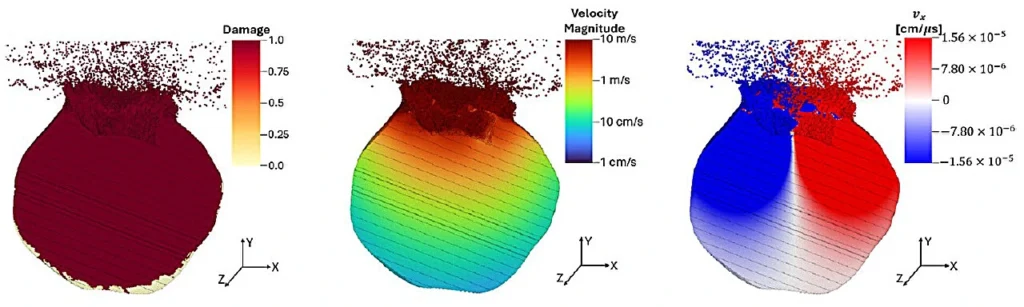
The longest-running simulation produced the clearest example. About 98% of the modeled asteroid material reached a fully damaged state, meaning that it had severely lost its ability to remain mechanically intact, while roughly 97% was moving faster than the body’s escape velocity. Material exceeding escape speed has enough velocity to overcome the modeled asteroid’s gravitational pull if its subsequent trajectory is not altered by interactions with other fragments. The simultaneous appearance of widespread damage and outward material motion is why the researchers placed the calculation near the robust-disruption regime rather than treating damage alone as sufficient evidence.
The simulations showed why the distance of the burst matters. In one case, a detonation farther from the asteroid deposited less total energy but spread that energy across a wider surface area, producing more widespread damage. LLNL cautioned that this does not mean a more distant burst is generally more effective; the response depends on the asteroid’s size, shape, composition and the mission objective.
The mainh uncertainty appears after the stage reached by the calculations. LLNL described robust disruption as requiring no remaining fragment larger than about 10 m (33 feet) and requiring the fragments to disperse instead of gravitationally reaccumulating. The simulations did not run long enough to produce the final fragment field needed to test those conditions. The peer-reviewed paper stops short of claiming robust disruption, stating instead that the damage and bidirectional motion place two cases near that regime.
Computational cost is a major reason for that limit. LLNL reported that the longest calculation used 1 680 processors for 59 days while advancing the modeled asteroid through only 145 milliseconds of physical evolution. Extending the calculations long enough to resolve fragment sizes, trajectories and possible reaccumulation would require substantially more computation.
Future work is intended to move beyond the simplified monolithic asteroid used here. The researchers plan to improve simulation speed and resolution, examine more realistic structures including loosely bound rubble-pile asteroids, and compare the numerical results with small-scale laboratory experiments. Internal structure matters because porosity, fractures, strength and morphology change how deposited energy and shocks propagate through an asteroid, and the paper identifies these properties as important uncertainties in disruption criteria.
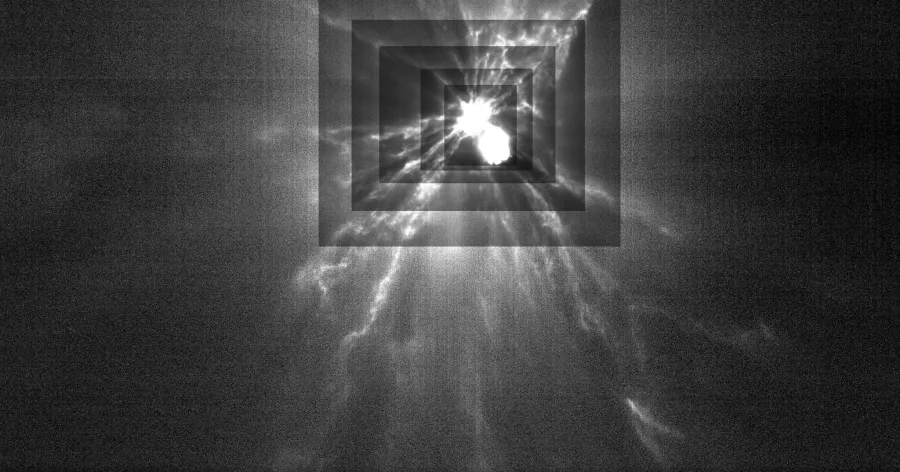
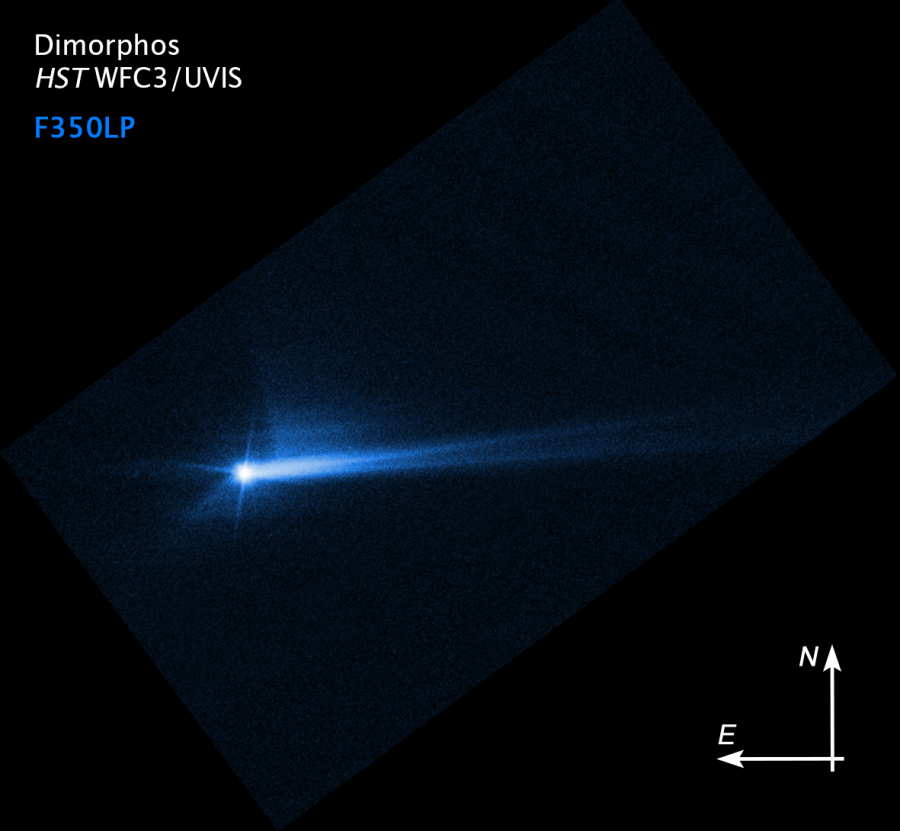
Nuclear mitigation occupies a different part of the planetary-defense toolbox from the kinetic-impact technique already tested in space. NASA’s Double Asteroid Redirection Test (DART) struck the asteroid moonlet Dimorphos in September 2022 and measurably shortened its orbit around Didymos, demonstrating asteroid deflection by kinetic impact. Nuclear devices offer much more energy than a spacecraft impactor and are studied as an option for larger objects or shorter warning times, although the LLNL work remains simulation research rather than an operational demonstration.
The unresolved fragment field is central to what the new modeling does and does not establish. The calculations provide a three-dimensional view of how damage, fracture and bulk motion develop during a nuclear disruption attempt, but determining whether those processes end in a defensible mitigation outcome will require longer calculations, more realistic asteroid structures and experimental validation.
References:
1 Santistevan, I. B., Burkey, M. T., Owen, J. M., Kumamoto, K. M., Pearl, J. M., & Managan, R. A. (2026). Nuclear mitigation of hypothetical asteroid threats in smoothed particle hydrodynamics. The Planetary Science Journal, 7, 196. https://doi.org/10.3847/PSJ/ae8a49
2 LLNL simulations explore nuclear mitigation of asteroid threats – Lawrence Livermore National Laboratory – October 13, 2026

I’m a science journalist and researcher at The Watchers, contributing to the Epicenter edition, where I cover peer-reviewed scientific research and emerging discoveries across Earth and space sciences. With a background in astronomy and a passion for environmental science, I’ve worked in shark and coral conservation in Fiji, conducting reef and shark-behavior research, contributing to mangrove restoration, and earning PADI Open Water and Coral Reef Certifications. I bring a blend of scientific rigor and storytelling to illuminate the discoveries shaping our planet and beyond.
Published in the last 24 hours
- NASA built the Opportunity rover to last 90 days on Mars, and Martian winds helped keep it alive for nearly 15 years by blowing dust off its solar panels, until a planet-wide dust storm in 2018 blocked sunlight and silenced the rover Epicenter
- On 28 August 1859 a solar storm shocked telegraph operators and threw sparks on other lines, and on 2 September Boston to Portland clerks unhooked their batteries and kept sending for more than two hours on the aurora's current alone. Epicenter
- In the winter of 1811–12, earthquakes near New Madrid, Missouri, shook so hard that witnesses saw the Mississippi River flow backward, and the shaking left a brand-new lake in Tennessee Epicenter
- In 2019, the Ronald Reagan Presidential Library hired hundreds of goats to eat 13 acres of brush around it; months later the Easy Fire surrounded the library, and the fire break the goats left behind slowed the flames before they reached the building Epicenter
