M6.1 earthquake hits South Sandwich Islands region
A strong earthquake registered by the USGS as M6.1 hit the South Sandwich Islands region at 13:48 UTC on January 1, 2025. The agency is reporting a depth of 83 km (51 miles).


I'm a dedicated researcher, journalist, and editor at The Watchers. With over 20 years of experience in the media industry, I specialize in hard science news, focusing on extreme weather, seismic and volcanic activity, space weather, and astronomy, including near-Earth objects and planetary defense strategies. You can reach me at teo /at/ watchersnews.bigscoots-staging.com.
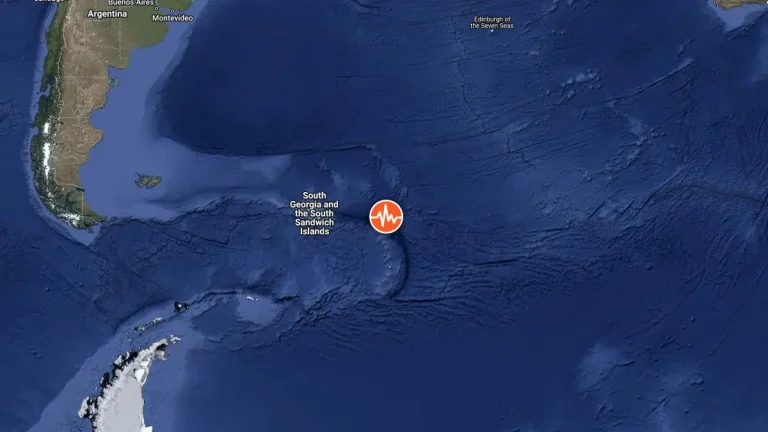
A strong earthquake registered by the USGS as M6.1 hit the South Sandwich Islands region at 13:48 UTC on January 1, 2025. The agency is reporting a depth of 83 km (51 miles).

At least two coronal mass ejections (CMEs) are heading toward Earth, with impacts expected on December 31 and January 1, 2025. The first CME — much stronger, was produced by a filament eruption associated with an M2.0 flare at 04:30 UTC on December 29 from Active Region (AR) 3939. This resulted in an asymmetric, partial-halo CME first seen in NASA coronagraph imagery at approximately 06:24 UTC.

Solar activity increased to high levels on December 29 and 30, 2024, producing more than 20 M- and 3 X-class solar flares in just over 24 hours. At least one of these events produced an Earth-directed coronal mass ejection (CME) – with impact expected on December 31. As a result, a G3 – Strong Geomagnetic Storm Watch is in effect.

A major X1.1 solar flare erupted from Active Region 3936 at 07:18 UTC on December 29, 2024. The event started at 07:08 and ended at 07:34 UTC. Two CMEs were noted in LASCO imagery following multiple solar flares today. Initial analysis indicates at least one has a likely Earth-directed component, with a possible arrival early on December 31.

A strong earthquake registered by the JMA as M6.7 hit Kuril Islands, Russia at 12:47 UTC on December 27, 2024. The agency is reporting a depth of 160 km (100 miles). USGS and EMSC have also registered it as M6.7 at same depth.

A coronal mass ejection (CME) produced on December 13, 2024, impacted Earth at 05:19 UTC on December 17, sparking G1 – Minor geomagnetic storming. The K-index reached 5 at 08:07 UTC, with effects limited to areas poleward of 60 degrees geomagnetic latitude. Enhanced solar wind conditions, driven by a positive polarity coronal hole high-speed stream (CH HSS), are expected to continue through December 18. Meanwhile, solar activity remains low, with a 30-40% chance of M-class flares and a 5% chance of X-class flares through December 19.

A very strong earthquake registered by the USGS as M7.3 hit Vanuatu at 01:47 UTC (12:47 LT) on December 17, 2024. The agency is reporting a depth of 57.1 km (35.5 miles). EMSC is reporting M7.4 at a depth of 28 km (17 miles).

A strong earthquake registered by the USGS as M6.4 hit the Chile-Argentina border region at 23:38 UTC (20:38 LT) on December 13, 2024. The agency is reporting a depth of 110 km (68 miles). EMSC is reporting the same magnitude and depth. CSN Chile is reporting M6.3 at a depth of 114 km (70 miles).
New activity/unrest was reported for 7 volcanoes from December 4 to 10, 2024. During the same period, ongoing activity was reported 17 volcanoes.
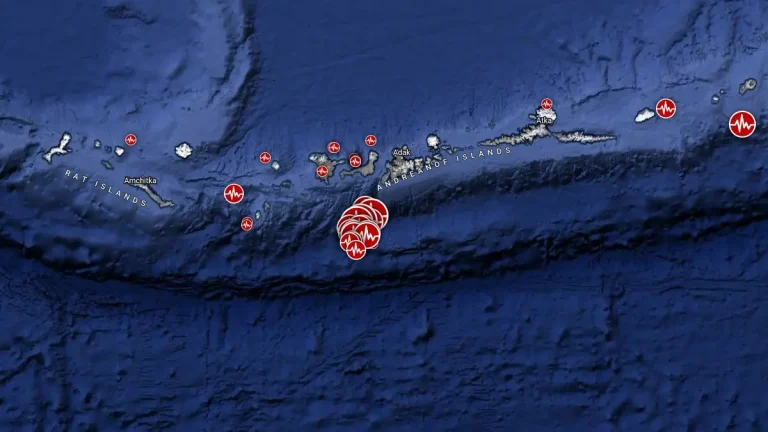
An earthquake swarm has been occurring southwest of Adak Islands, Alaska, since December 8, 2024, beginning with M6.3 at a depth of 18 km (11 miles). The swarm includes multiple significant earthquakes, including two M6.3 events, an M6.1, and numerous aftershocks up to M5.8.
