
A volcano in Tonga exploded so loudly in 2022 that people in Alaska, 6,000 miles away, were woken by the booms. Hawaii, at half that distance, heard nothing at all
people across Alaska awoke to repeated booms about nine hours after Hunga Tonga–Hunga Haʻapai erupted on January 15, 2022, sending pressure waves nearly 10 000 km (6 200 miles) away. In Palmer, Iris Caldentey went outside to check whether someone was breaking into the family’s cars; in Unalaska, Laresa Syverson initially blamed her cat. Yet Hawai‘i, roughly halfway between the volcano and Alaska, recorded the pressure wave on instruments without a single reported account of anyone hearing the eruption.
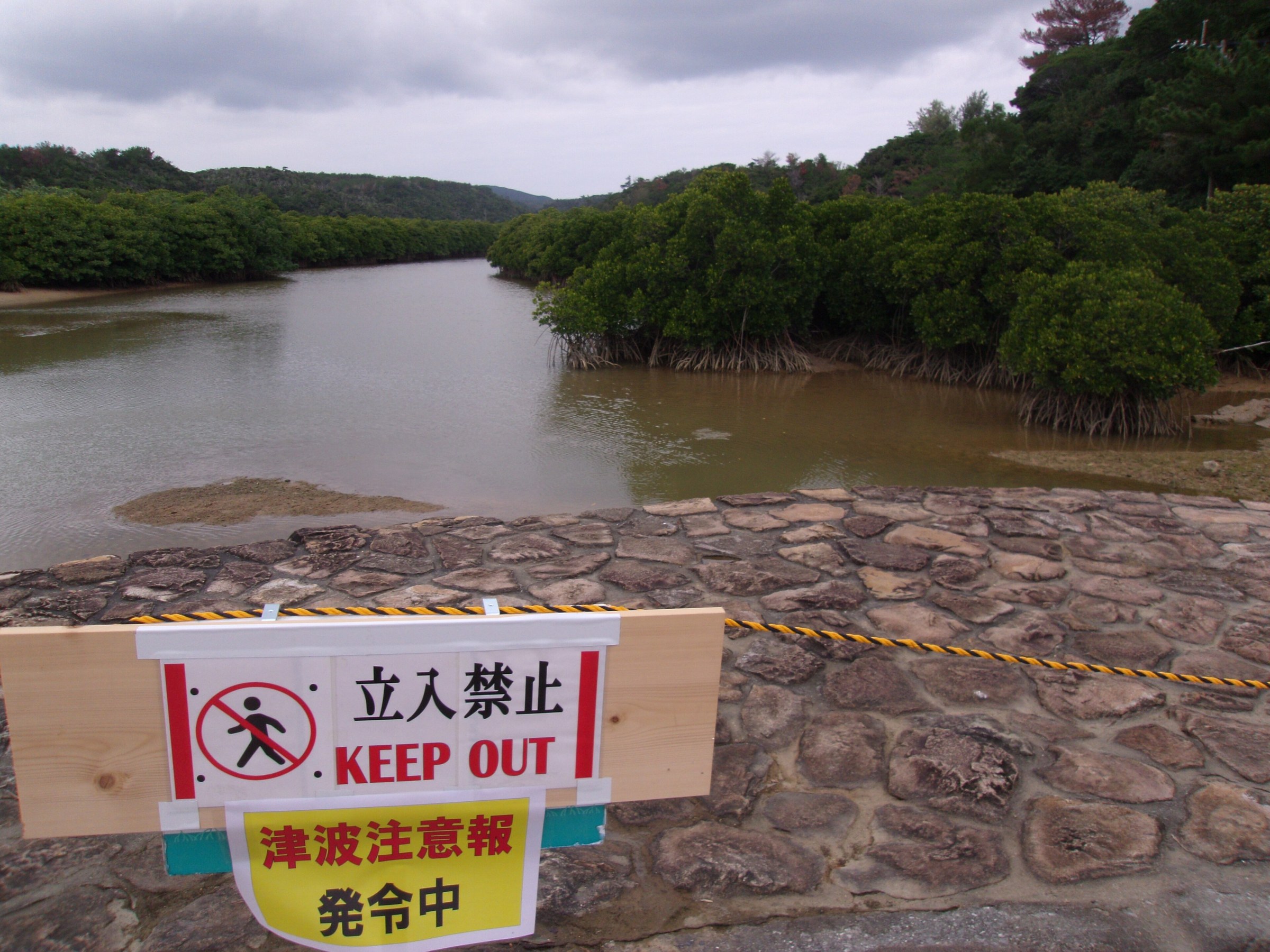
2022 Tonga Tsunami warning! in Gesashi mangrove bay. Credit: Indiana jo (CC BY-SA 4.0), via Wikimedia Commons.
About nine hours after Hunga Tonga–Hunga Haʻapai’s climactic eruption on January 15, 2022, people across Alaska woke to repeated booms from an event nearly 10 000 km (6 200 miles) away. One woman went outside to check whether someone was breaking into the family’s cars. Another blamed her cat before considering fireworks or the bass from a car stereo.
Hawai‘i was only about 4 900 km (3 000 miles) from the volcano. Its instruments recorded a large pressure pulse just over four hours after the eruption, but the U.S. Geological Survey’s Hawaiian Volcano Observatory reported no accounts of anyone hearing it. The pressure wave did not skip Hawai‘i: most of the signal there was below the range of human hearing, while scientists concluded that the audible booms in Alaska were probably generated somewhere along the atmospheric path rather than traveling directly from the volcano as ordinary sound.
Alaska woke to booms from the South Pacific
The largest explosion in the eruption sequence occurred at about 04:10 UTC on January 15, roughly 64 km (40 miles) north of Tonga’s capital, Nukuʻalofa. Satellite images showed the umbrella cloud expanding across hundreds of kilometers while pressure waves spread outward through the atmosphere.
In Alaska, the most audible energy reached monitoring instruments at about 04:30 local time. Reports came from communities extending from Juneau through south-central Alaska to the Aleutian Islands. In Palmer, Iris Caldentey awoke to what she described as “constant, boom, boom, boom” and checked the cars outside because she suspected a burglar. In Unalaska, Laresa Syverson’s first thought was: “I thought for sure it was my cat.”4
The reports were initially difficult even for specialists to accept. Kenneth Macpherson of the Wilson Alaska Technical Center said the timing and sensor data persuaded him that the sounds were associated with Hunga. David Fee, a co-author of the later global analysis, also heard the booms without recognizing their source at the time.
For Alaskans, the eruption arrived as a strange noise in the dark. In Tonga, it was a catastrophe. The explosion, tsunami and ashfall destroyed homes, contaminated water supplies and severed the country’s submarine communications cable. A World Bank assessment estimated direct damage at US$90.4 million, equivalent to about 18.5% of Tonga’s gross domestic product at the time.
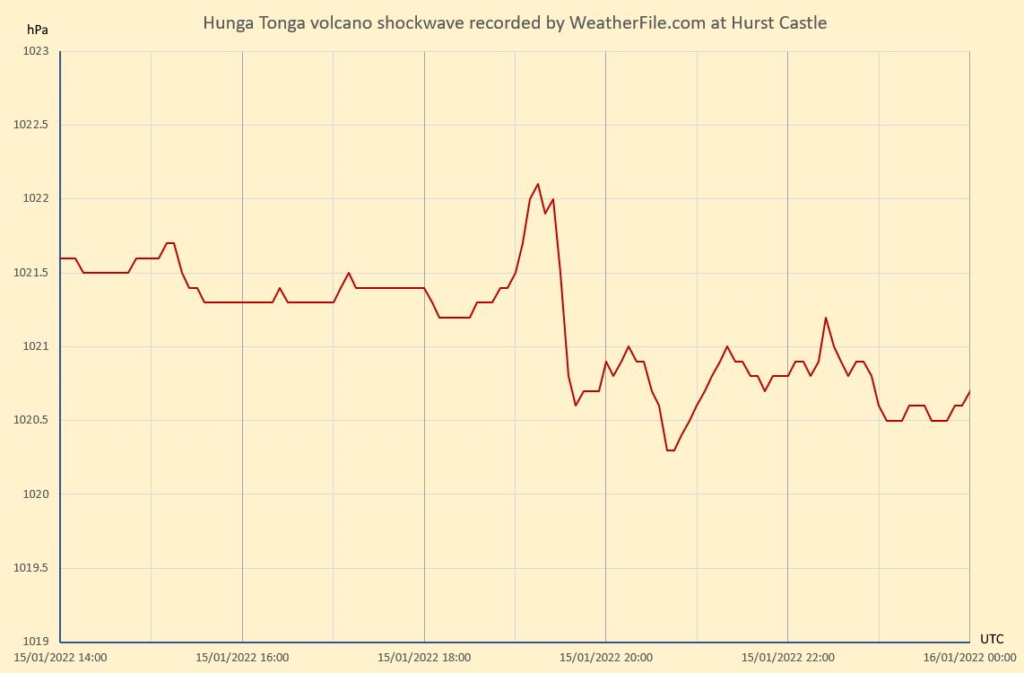
Hawai‘i recorded the wave but did not hear it
The contrast with Hawai‘i is the part of the story that sounds impossible. Hunga’s main explosive phase occurred from about 18:10 to 18:30 HST on January 14. At approximately 22:40 HST, pressure sensors south of Kīlauea’s summit recorded a large pulse from the eruption. The arrival time was consistent with an atmospheric wave moving at roughly 1 100 km/h (700 mph).
Those instruments are microphone-like sensors designed to detect volcanic explosions, including frequencies below human hearing. The signal began with broad, slow pressure changes and later oscillated more quickly. The human ear generally detects frequencies above about 20 cycles per second, or 20 Hz; the USGS said most of the waves in the Hawaiian records were too low in frequency to be heard.
“In Hawaii, there were no reports of the Tonga eruption being heard,” the Hawaiian Volcano Observatory wrote. That is a statement about reported human hearing, not an assertion that no person anywhere in the islands could possibly have heard anything. More importantly, it does not mean that the atmospheric disturbance failed to reach Hawai‘i. Instruments captured it clearly, and gravity waves associated with the eruption were seen in airglow over Mauna Kea about four and a half hours after the blast.
The booms probably did not travel straight from Tonga
Sound is a pressure wave in air, but not every pressure wave is audible. High-frequency waves are absorbed and scattered more rapidly as they travel. Low-frequency infrasound has a much better chance of crossing oceans and continents, which is why global monitoring networks use it to detect distant volcanic eruptions and nuclear explosions.
Earth’s atmosphere is also not uniform. Temperature and wind change with altitude, creating layers that can bend, guide, or weaken pressure waves. Those conditions help explain how low-frequency energy from Hunga traveled around the world, but they do not by themselves explain a direct audible sound surviving all the way from Tonga to Alaska.
Robin Matoza of the University of California, Santa Barbara, who led the 2022 Science paper, said standard sound models could not reproduce such extreme audible propagation. The team’s interpretation was that the audible components were “generated somewhere along the path by nonlinear effects.” In other words, Alaska did not necessarily hear one conventional boom that left the vent and remained audible for nearly 10 000 km. Powerful lower-frequency waves may have developed new higher-frequency components while moving through the atmosphere.
Later observations strengthened that interpretation
A later study examined audible and infrasonic records across Aotearoa New Zealand, about 2 000–3 200 km (1 240–1 990 miles) from Hunga. Researchers identified two packets of audible waves and found that their arrival times were consistent with nonlinear processes acting during the passage of much lower-frequency atmospheric waves.
One of those was the Lamb wave, a large pressure disturbance guided by the atmosphere. The other was associated with a Pekeris wave, an atmospheric resonance mode that the authors said had not previously been observed from an eruption of this kind. The New Zealand findings do not prove precisely where the Alaskan booms formed, but they provide independent evidence that a powerful, initially sub-audible disturbance can produce audible energy as it propagates.
They still do not yield a simple answer to the Hawai‘i–Alaska contrast. The available studies do not establish a single acoustic shadow over Hawai‘i, nor do they show that distance alone determined who heard the eruption. Direction, winds, temperature structure, frequency, and the location at which audible components formed may all have mattered. The exact combination remains a research question.
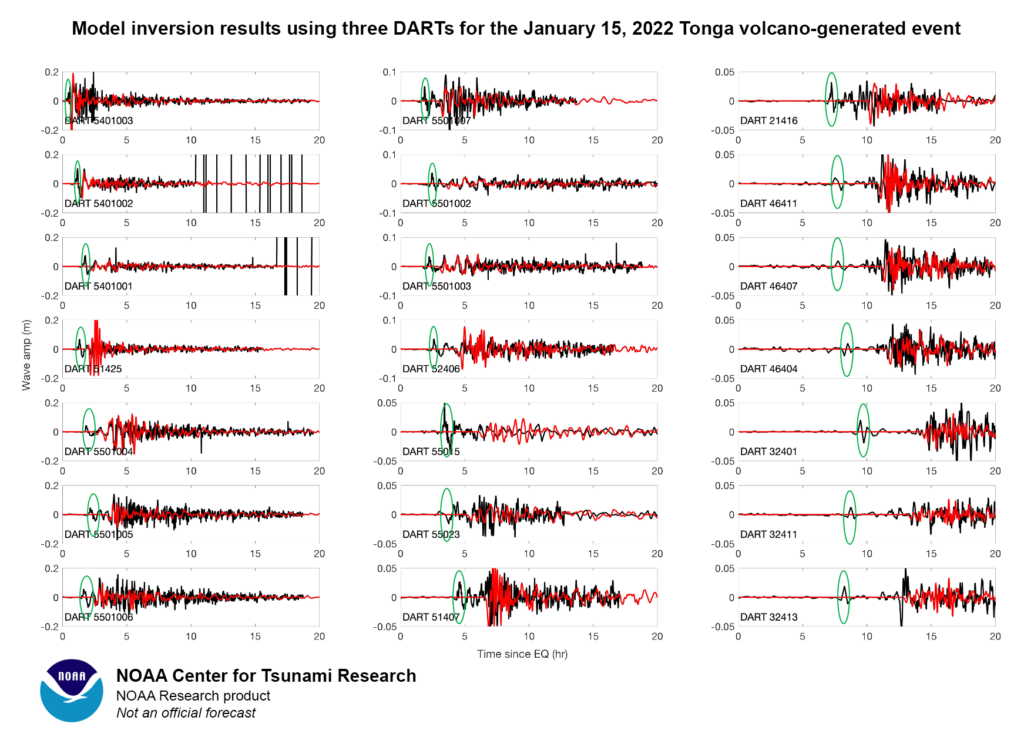
A pressure wave circled Earth again and again
The Alaskan booms were only one part of Hunga’s atmospheric signature. Matoza and 75 co-authors from 17 countries assembled barometer, infrasound, seismic, and ionospheric observations from around the world. They found a Lamb wave at frequencies at or below 0.01 Hz, global infrasound across a much broader frequency range, and detectable disturbances extending into the ionosphere.
The Lamb wave traveled around Earth four times in one direction and three times in the other over six days. Its amplitude was comparable to the atmospheric wave produced by Krakatau in 1883, making Hunga the largest volcanic atmospheric-wave event documented since that eruption. The difference was observational: Krakatau left scattered barometer records, while Hunga passed through a planet covered by pressure sensors, seismometers, satellites, and connected eyewitnesses.
The 2022 research team described the Alaska accounts as the farthest documented audible sounds from their source then available. That superlative now needs qualification. A 2023 study reported reliable accounts of thunder-like sounds in southwestern Germany, more than 17 000 km (10 600 miles) from Hunga, and proposed that intense volcanic lightning generated the high-frequency signals detected there. Those later reports do not change what happened in Alaska, but they show how quickly the record evolved after the eruption.
Why the silence in Hawai‘i matters
The easy version of the story is that Hunga was simply loud enough to be heard 10 000 km away. The measurements point to something more interesting: an enormous explosion loaded the atmosphere with energy across many frequencies, the atmosphere sorted and transformed that energy as it traveled, and audible booms emerged in places where distance alone would not have predicted them.
That distinction matters beyond one eruption. The same sensor networks are used to monitor volcanoes, earthquakes, and prohibited nuclear tests. Understanding how atmospheric waves change frequency, couple into the ground and ocean, and reappear as sound far from their source helps analysts locate events and avoid mistaking one kind of signal for another.
Hunga has continued to reshape atmospheric science. A later international assessment documented effects ranging from stratospheric water vapor to upper-atmospheric disturbances. The Alaskan booms and Hawai‘i’s instrumentally recorded silence are a small but vivid part of that larger record: what people hear after a distant explosion depends not only on how far away they are, but on what the atmosphere does in between.
References:
1 Matoza, R. S., et al. (2022). Atmospheric waves and global seismoacoustic observations of the January 2022 Hunga eruption, Tonga. Science, 377(6601), 95–100. https://doi.org/10.1126/science.abo7063
2 Hunga volcano eruption provides an explosion of data – University of Alaska Fairbanks Geophysical Institute – May 12, 2022
3 Eruption’s Echoes – University of California, Santa Barbara – May 12, 2022
4 Lamb, O. D., Jarvis, P. A., & Kilgour, G. (2025). Audible and infrasonic waves generated during the 2022 Hunga eruption: Observations from across Aotearoa New Zealand. Journal of Volcanology and Geothermal Research, 457, 108232. https://doi.org/10.1016/j.jvolgeores.2024.108232
5 Kraft, T., Ling, O. K. A., Toledo, T., Scheu, B., Stähler, S. C., Clinton, J., & Stange, S. (2023). An antipodal seismic and (infra)acoustic view from Central Europe on the 15 January 2022 Hunga–Tonga–Hunga–Ha’apai eruption. Seismological Research Letters, 94(3), 1318–1333. https://doi.org/10.1785/0220220254

Rishav Kothari is Editor-in-Chief of The Watchers, where he runs the newsroom and covers earthquakes, volcanoes, severe weather and space weather.
