
Flash flooding kills one, prompts around 90 rescues in Madrigueras, Spain
Flash flooding killed a 102-year-old woman and prompted the rescue of around 90 people in Madrigueras, Albacete Province, Spain, on October 2, 2026, after more than 140 mm (5.51 inches) of rain fell in approximately two hours. Regional authorities kept METEOCAM at Emergency Phase, Operational Situation 1, on October 3 as recovery and cleanup operations continued.
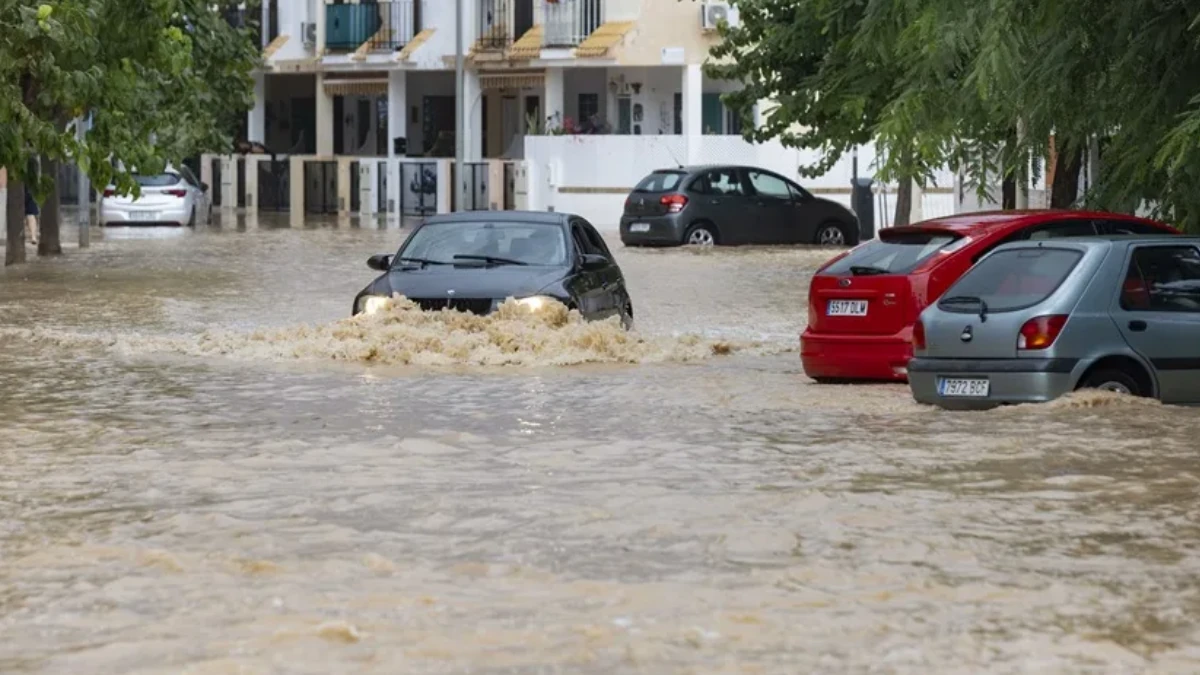
A car drives through a flooded street in Los Alcázares, Murcia, Spain on October 2, 2026. Credit: EFE/Marcial Guillén
The most intense phase began around 18:15 LT (16:15 UTC) on October 2 and continued for approximately two hours, regional government representative Pedro Antonio Ruiz Santos said.
Preliminary regional government data indicated that more than 140 mm (5.51 inches) of rain fell during that period. Other reports citing the regional government placed the total at 142 mm (5.59 inches) over approximately two to two-and-a-half hours.
Runoff subsequently arrived through normally dry drainage channels, known locally as ramblas, and from surrounding higher ground, worsening the flooding after the heaviest rain had eased.

A 102-year-old woman was found dead in her home after floodwater rose above 1 m (3.3 feet), according to EFE and the regional government. Emergency personnel rescued around 90 people, primarily from flooded homes, during the afternoon and early evening.
Floodwater also entered the Madrigueras health center. Medical services were temporarily transferred to the local Red Cross facility, where staff continued providing care.
Mayor Juan Carlos Talavera said on October 3 that four homes had collapsed, more than 150 vehicles had been removed, and no one remained missing. Mud, debris and standing water continued to affect streets, homes, businesses and public buildings.

Additional teams and trucks from the regional environmental-response agency GEACAM joined the recovery operation on October 3.
They supported the provincial fire service, Guardia Civil, local police, Civil Protection, Red Cross and crews from neighboring municipalities in clearing mud, removing vehicles and assisting residents.
Regional President Emiliano García-Page said his government would ask Spain’s central government on October 6 to designate Madrigueras as an area seriously affected by a civil protection emergency, commonly described as a disaster area.
The designation would provide access to state assistance for damage, particularly to private property and vehicles.

AEMET said the broader rainfall episode began on October 1 as cold air entered the middle and upper atmosphere while moist air moved inland from the Mediterranean. The agency warned that intense storms could cause sudden flooding in low-lying areas, streams and normally dry channels.
A detached upper-level low, known in Spain as a DANA, was forecast to become established west of the Iberian Peninsula and maintain unstable conditions through October 4.
AEMET forecast more than 100 mm (3.94 inches) in 12 hours along parts of the Balearic Sea coast on October 3, with locally torrential rain possible near Barcelona late in the day.
For October 4, AEMET forecasts rainfall exceeding 200 mm (7.87 inches) in 12 hours in parts of Barcelona and Girona provinces.
The agency warned that the precise location and timing of the heaviest rain remained uncertain and that repeated storms over already saturated areas would increase the flooding danger.
Reference:
1 Regional government maintains METEOCAM Level 1 and coordinates recovery in Madrigueras – Government of Castilla-La Mancha – October 3, 2026
2 One woman dead and 90 people rescued in the Madrigueras flood – RTVE – October 3, 2026
3 Regional government to request disaster-area designation for Madrigueras – Government of Castilla-La Mancha – October 3, 2026

Rishav Kothari is Editor-in-Chief of The Watchers, where he runs the newsroom and covers earthquakes, volcanoes, severe weather and space weather.
Published in the last 24 hours
- In September 1859, a solar storm lit up the night sky so brightly that gold miners in the Rocky Mountains woke up after midnight and started cooking breakfast, convinced the aurora glowing over their camp was the sunrise Epicenter
- A patch of warm Pacific water that could become the strongest El Niño in more than 70 years sits thousands of miles from any American town, yet it is already the main reason NOAA expects a wetter winter across the South and a milder one across the North
- A 19-year-old Nebraska teacher reportedly tied her pupils together with twine and led them to safety through a blizzard in January 1888 Epicenter
- NASA built the Opportunity rover to last 90 days on Mars, and Martian winds helped keep it alive for nearly 15 years by blowing dust off its solar panels, until a planet-wide dust storm in 2018 blocked sunlight and silenced the rover Epicenter
