
Southern Kamchatka shifted 2 m (6.6 feet) during M8.8 earthquake on July 29, 2025
Preliminary data from KBGSRAS shows that the southern part of the Kamchatka Peninsula shifted southeastward by nearly 2 m (6.6 feet) after M8.8 earthquake on July 29. This is comparable in scale to displacement observed during the 2011 M9.1 Tōhoku earthquake in Japan.

Southern Kamchatka shifted 2 m (6.6 feet) during M8.8 earthquake of July 29, 2025. Credit: GS RAS
Preliminary geodynamic calculations by the Kamchatka Branch of the Geophysical Survey of the Russian Academy of Sciences (KBGSRAS) indicate significant coseismic deformation across the Kamchatka Peninsula following tsunami-producing M8.8 Kamchatka earthquake at 23:24 UTC on July 29 2025.
Maximum horizontal ground displacements were recorded in the southern part of the peninsula, where shifts reached nearly 2 m (6.6 feet) in the southeastward direction. According to KBGSRAS, the displacements are comparable in scale to those observed during the 2011 M9.1 Tōhoku earthquake in Japan.
The Petropavlovsk cluster of GNSS stations, including Petropavlovsk-Kamchatsky, experienced measurable but lower levels of displacement.
The pattern of motion is consistent with a preliminary fault slip model that places the highest coseismic slip on the southern flank of the rupture zone. This distribution corresponds with observed macroseismic intensity, which was notably stronger in Severo-Kurilsk and weaker in Petropavlovsk-Kamchatsky.
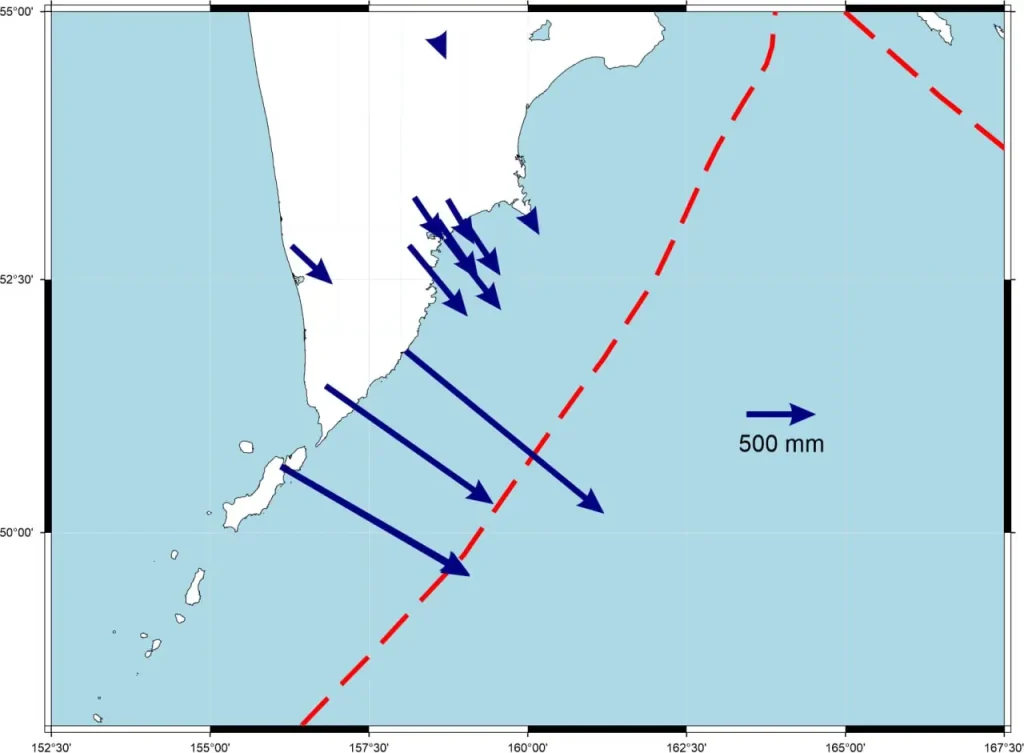
The direction of motion across the peninsula generally indicates southeastward displacement of crustal blocks, in line with the regional tectonic stress regime and subduction zone geometry.
Further modeling, including InSAR and postseismic GNSS analysis, is expected to refine the rupture characteristics and ground deformation field.
The M8.8 quake was preceded by multiple strong foreshocks, including M7.4 and three M6.6 on July 20, and followed by more than 420 earthquakes, with 9 above M6.

Read more:
1 Powerful M8.8 earthquake and tsunami strike Kamchatka Peninsula, sixth strongest earthquake on record – The Watchers – July 30, 2025
2 Rare footage shows large tsunami waves hitting Kamchatka coast after M8.8 earthquake, Russia – The Watchers – August 4, 2025
3 Record tsunami waves cause nearly USD 1 million in damages at Crescent City Harbor, California – The Watchers – August 3, 2025

Teo Blašković founded The Watchers in 2011 and edited it until 2026, covering seismic and volcanic activity, extreme weather, space weather and near-Earth objects. Articles on this page are his archive.
Published in the last 24 hours
- In September 1859, a solar storm lit up the night sky so brightly that gold miners in the Rocky Mountains woke up after midnight and started cooking breakfast, convinced the aurora glowing over their camp was the sunrise Epicenter
- A patch of warm Pacific water that could become the strongest El Niño in more than 70 years sits thousands of miles from any American town, yet it is already the main reason NOAA expects a wetter winter across the South and a milder one across the North
- A 19-year-old Nebraska teacher reportedly tied her pupils together with twine and led them to safety through a blizzard in January 1888 Epicenter
