
Study of Iceland volcano eruption reveals new insights into volcanic fountaining
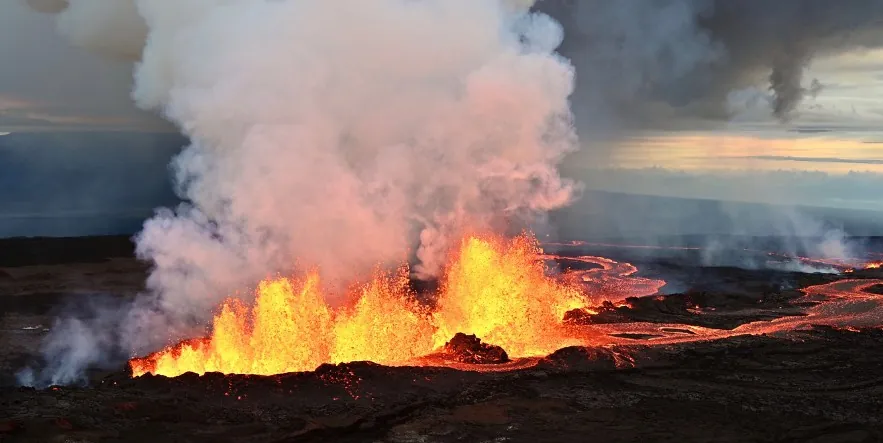
Image credit: USGS/HVO
A team of Earth scientists, meteorologists, geologists, and volcanologists has formulated a new theory explaining the phenomenon of volcanic fountaining. This breakthrough is based on the analysis of the 2021 Fagradalsfjall eruption in Iceland, as reported in the journal Nature Communications.
In a recent publication in Nature Communications, a multi-disciplinary team has unveiled a novel theory elucidating the mechanics of volcanic fountaining. This theory stems from their detailed study of the Fagradalsfjall volcano eruption in Iceland, which occurred in 2021.
Volcanic fountaining, characterized by explosive eruptions with lava shooting skywards and cascading down a volcano’s sides, has long puzzled scientists.
The team’s research centered on understanding the driving forces behind this dramatic natural phenomenon. Unlike a single massive eruption, the Fagradalsfjall event presented a series of lava fountains of varying heights, providing a unique opportunity for close-up examination.

To probe the eruption’s dynamics, the researchers employed open-path Fourier transform infrared (OP-FTIR) spectroscopy. This technique enabled them to analyze the gas emissions from the volcano across multiple eruption and pause cycles. Their investigation into the gas composition yielded clues about the processes underpinning volcanic fountaining.
The team’s emerging theory posits that volcanoes like Fagradalsfjall have a magma-filled shallow cavity beneath their calderas. Magma rising into this cavity generates a foam layer at the top. The researchers suggest that the collapse of this foam layer creates the pressure needed to propel magma upwards, akin to soda being ejected from a shaken can. This process, they theorize, occurs cyclically, leading to the observed fountain-like eruptions.
The study not only offers a compelling explanation for the Fagradalsfjall eruption’s unique characteristics but also has broader implications. The researchers believe that their theory could apply to various types of volcanic fountains observed worldwide.
Further research is needed to validate and expand upon these findings. However, the team’s work provides significant insights into the intricate processes of volcanic fountaining, potentially revolutionizing our understanding of this spectacular volcanic activity.
References:
1 A new theory to explain the nature of volcanic fountaining – Science X Network – November 25, 2023
2 Near-surface magma flow instability drives cyclic lava fountaining at Fagradalsfjall, Iceland – Scott, S., Pfeffer, M., Oppenheimer, C. et al. – Nature Communications – November 7, 2023 – DOI https://doi.org/10.1038/s41467-023-42569-9 – OPEN ACCESS

The Watchers team and our contributors bring the latest on extreme weather, earthquakes, volcanic eruptions, space weather, and all things science. We're all about making sense of the natural world and keeping you informed on what’s happening. Got a tip or a question? Hit us up using the form at newstips!
Published in the last 24 hours
- In September 1859, a solar storm lit up the night sky so brightly that gold miners in the Rocky Mountains woke up after midnight and started cooking breakfast, convinced the aurora glowing over their camp was the sunrise Epicenter
- A patch of warm Pacific water that could become the strongest El Niño in more than 70 years sits thousands of miles from any American town, yet it is already the main reason NOAA expects a wetter winter across the South and a milder one across the North
- A 19-year-old Nebraska teacher reportedly tied her pupils together with twine and led them to safety through a blizzard in January 1888 Epicenter
