
All-out efforts to protect nuclear power plant from massive wildfire, South Korea

Image credit: Korea Wildfire Service
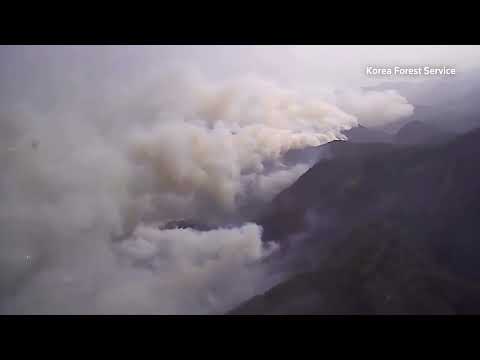
A massive wildfire that broke out in South Korea’s eastern coastal county of Uljin forced President Moon Jae-in to order all-out efforts to protect the nearby Hanul Nuclear Power Plant on Friday, March 4, 2022.
The government issued a natural disaster alert after a wildfire broke out in the county of Uljin, North Gyeongsang Province on Friday, about 10 km (6.2 miles) from the Hanul Nuclear Power Plant.1
“Place the top priority on preventing casualties and put every possible effort into swiftly putting out the fire,” Moon told officials after being briefed on the wildfire.
Dozens of helicopters and about 1 000 firefighters were sent to the scene to contain the blaze and prevent it from spreading to the power plant.2
The fire reached the perimeter of the utility, forcing the operator to reduce operations to 50%, but the plant has sustained no damage so far, according to the Korea Forest Service.
“We have formed a line of defense there,” a forest service official said on TV, referring to the perimeter of the plant. “We are not seeing any big damage near the nuclear plant area as of now.”
Later in the day, winds drove the fire northward toward Samcheok.
At least 22 homes and 9 other buildings were destroyed.
About 4 000 residents were evacuated early Friday morning, but most of them returned by the end of the day.

References:
1 S.Korea’s Moon orders protection of nuclear power plant amid wildfire – Reuters
2 South Korea scrambles to put out wildfire near nuclear power plant – Kyodo

Teo Blašković founded The Watchers in 2011 and edited it until 2026, covering seismic and volcanic activity, extreme weather, space weather and near-Earth objects. Articles on this page are his archive.
Published in the last 24 hours
- In 2013 a landslide fell onto Svínafellsjökull in southeast Iceland, leaving thicker ice at the foot of the slope; that ice is now moving away and the mountainside has shifted 1 to 3 cm. Epicenter
- Kīlauea's north vent threw lava about 660 feet (200 m) high for six hours on 5 November 2026; the summit is now reinflating, with the next episode forecast for 16 to 21 November. Epicenter
- A crack up to 6 m (20 ft) wide is splitting the summit of the Hochvogel in the Allgäu Alps; 12 years of measurements now put the loose block at about 400,000 cubic metres, half the peak. Epicenter
- Hayli Gubbi in Ethiopia's Afar erupted on 23 November 2025, its first historically documented eruption; a year later scientists have traced it to magma from Erta Ale that travelled more than 30 km underground. Epicenter

IF YOU CO-OPERATE WITH JAMAL SHRAIR ALL NUCLEAR POWER PLANTS CAN BE REPLACED WITH CIVILIZED NUCLEAR POWER PLANTS (100% GREEN NUCLEAR ENERGY)
Foolish comment to make when nuclear plants are CURRENTLY threatened by both natural disasters and warfare. While nuclear power does not produce CO2, there is nothing “green” about radioactive waste. The risk of meltdowns is not trivial. Chernobyl and Fukushima will be dead zones FOREVER.