
Size of hazard area in Fagradalsfjall under re-evaluation after change in volcanic activity, Iceland

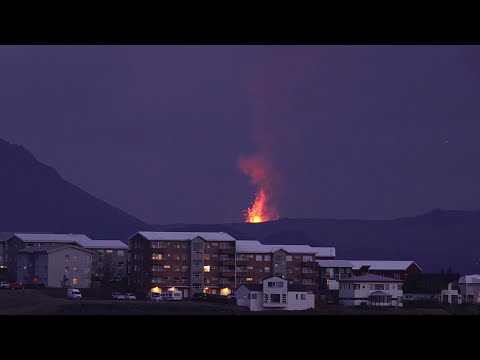
Image credit: Smári McCarthy
Authorities in Iceland are re-evaluating the size of the hazard area at the eruption site in Fagradalsfjall after a significant change in activity detected on May 2. The eruption in Fagradalsfjall continues through one main crater — the fifth fissure that opened in the area on April 13. The volcano started erupting on March 19, 2021, after a long period of intense seismicity.
The volcanic activity was characterized by continuous lava fountains since April 27, but the activity changed at around midnight UTC on May 2 and has since been showing pulsating behavior.
Here's a view of the volcanic eruption in Iceland from early this morning. pic.twitter.com/rOH8rkRePZ
— Smári McCarthy (@smarimc) May 3, 2021
These pulses have intermittent active periods of 8 – 12 minutes, with 1 – 2 minutes of rest periods in between.
The active pulses start with a strong fountain activity, with fountains reaching up to 100 – 150 m (330 – 500 feet) above ground level, and some even higher — up to 300 m (985 feet). These pulses are very apparent in the seismic tremor from seismic stations in a wide area around the eruption site.

On Sunday morning, just after 06:00 UTC, the wind direction changed to slow easterly, and a few hours later smoke was detected in the southwest slopes of Geldingadalir. Possibly, hot pyroxene from the eruptive crater has been carried by the wind to the southwest of the lava field for about 300 m (985 feet) distance and started a brush fire.
The Icelandic Met Office said it is not clear at this time what is causing these changes in volcanic activity, but changes in magma flow, the chemical composition of magma/gas, or possibly changes in the volcanic conduit cannot be ruled out.
Considering these changes in activity, the size of the hazard area at the eruption site is being re-evaluated, IMO said.
Geological summary
The Krýsuvík-Trölladyngja volcanic system is described by the Catalogue of Icelandic Volcanoes as an approximately 50 km (31 miles) long composite fissure swarm trending about N38°E, including a 30 km (18 miles) long swarm of fissures, with no central volcano.
It is one of the volcanic systems arranged en-echelon along the Reykjanes Peninsula west of Kleifarvatn lake.
The Fagradalsfjall and Krýsuvík fissure swarms are considered splits or secondary swarms of the Krýsuvík–Trölladyngja volcanic system.
Small shield volcanoes have produced a large portion of the erupted volume within the system.
Several eruptions have taken place since the settlement of Iceland, including the eruption of a large basaltic lava flow from the Ogmundargigar crater row around the 12th century.
The latest eruption, identified through tephrochronology, took place during the 14th century.

Teo Blašković founded The Watchers in 2011 and edited it until 2026, covering seismic and volcanic activity, extreme weather, space weather and near-Earth objects. Articles on this page are his archive.
Published in the last 24 hours
- High Risk of excessive rainfall covers Florida’s Space Coast as St. Johns River near Cocoa reaches 5.67 m
- Four small asteroids will pass close to Earth from November 21 to 23
- Cyclone Akvan weakens after landfall near Gopalpur; more than 300 000 evacuated in Odisha, India
- A broad low over southeastern Florida and the northwestern Bahamas has a 30 percent chance of subtropical or tropical development within 48 hours and a 50 percent chance within 7 days, the National Hurricane Center says
