
Major floods in Crete, streets turn into raging rivers, Greece

Image credit: John Drakkakis
Heavy rain hit parts of Greece on April 5 and 6, 2019, causing severe flooding with up to 3 m (10 feet) high floodwaters in Crete. This is the third severe flooding event to hit the country over the past 2 months.
Heavy rain started affecting parts of Greece late April 5, turning streets into raging rivers, flooding homes and businesses, causing landslides and collapsing traffic networks. Numerous cars were swept away and homes flooded, forcing authorities to launch rescue operations.

Image credit: NASA/NOAA Suomi NPP/VIIRS. Acquired April 6, 2019
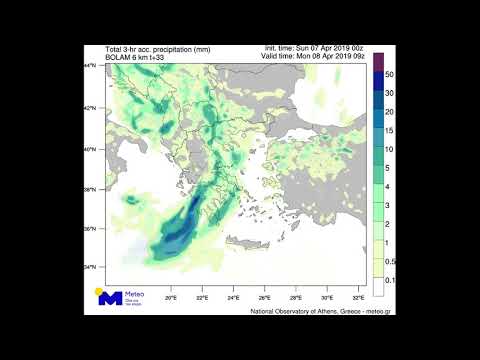
Parts of the region received more than 110 mm (4.33 inches) of rain in just 4 hours and up to 209 mm (8.22 inches) in 24 hours ending 19:00 LT, April 6.


3hr Precipitation Accumulation – April 5 – 6, 2019. Credit: earth.nullschool.net
Among the hardest hit are Archanes-Asterousia, Pyrgos, Harakas, Sampania, VIannos, Sitia, Agios Nikolaos and Ierapetra.
A historical bridge in Ierapetra, built in 1924, suffered severe damage and locals fear it might crash to pieces, Keep Talking Greece reported. This would be the third bridge to collapse in the region after two other in the prefecture of Chania in February 2019.
A big operation was underway to evacuate a family trapped in the floods in Pilalimata by Sitia in the Prefecture of Lasithi, Crete. Four children, two elderly and a woman have escaped on the rooftop after the water level reached a dangerous height of 3 m (10 feet).

Heavy rain also caused problems in other parts of the country, ekathimerini reports. Damage was reported in the Peloponnese and blackouts in several parts of Attica, including Neos Voutzas and Mati – towns ravaged in last summer's disastrous wildfires. Damage was also reported in Saronica, Keratea, Anthousaa, Porto Rafti and Kakia Thalassa.
Authorities urged people affected by the system to be cautious and avoid traveling unless absolutely necessary as more heavy rain and flooding is expected into the next week. Heavy rain and storms are expected throughout the country on April 8, with the strongest in the southern parts of the country.

Teo Blašković founded The Watchers in 2011 and edited it until 2026, covering seismic and volcanic activity, extreme weather, space weather and near-Earth objects. Articles on this page are his archive.
Published in the last 24 hours
- How did one flash of lightning, lasting about seven seconds, stretch 829 km across five US states, beat the previous record by 61 km, and only be recognized as the longest ever measured nearly eight years later?
- A meteorite blew a crater beside a village near Lake Titicaca in 2007, and dozens of villagers who went to see it got headaches and nausea, though tests found nothing the rock had added to the water Epicenter
- The people who pay closest attention to the weather are the ones storms have already cost the most, a study of 946 students found, with one damaging storm making little difference to how much attention a student paid, but two or more making a clear one Epicenter
- The sea is falling in Juneau, Alaska, because land freed from melted glaciers is rising about 0.6 inches a year Epicenter
