
2015 Orionid meteor shower peaks on October 21 – 22

Image credit: Imgur
Every October, stargazers all over the planet look forward to the annual Orionid meteor shower. The Orionids are popular because they are one of the two meteor showers created from the debris field of the extremely popular Halley's comet. The annual Eta Aquarids meteor shower in May being the second one. The Orionid meteor shower is not the strongest but it is considered one of the most beautiful meteor showers of the year.
The Orionids in 2015
The Orionids are so named as the shooting stars seemingly originate in the constellation Orion. In 2015, their visibility is expected to pickup after nightfall on October 20 with the Orionid meteor maximum occurring between the predawn hours of October 21 – 22. At its peak, the Orionid shower will dazzle the night sky with approximately 20 meteors being visible every hour.
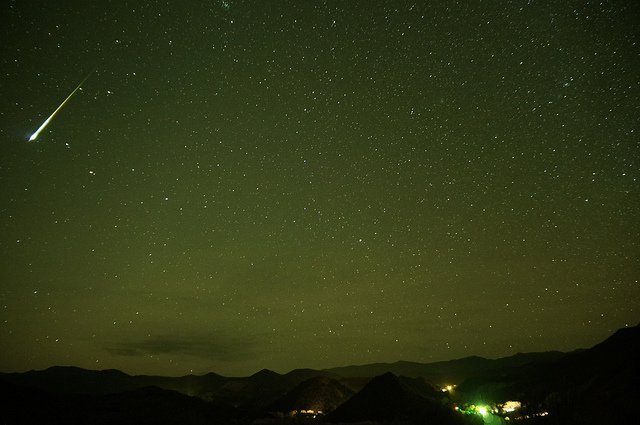
The Orionid meteor shower. Photo credit: Mike Lewinski (CC via Flickr)
Where to view the Orionid meteor shower
The Orionid meteor shower seems to radiate from the constellation Orion. Hence the best time to view the shower is when the radiant point (Orion) is visible over the eastern horizon. Generally, the visibility of any meteor shower is inversely proportional to the brightness of the moon. But since we have a first quarter moon setting by midnight on October 21 – 22, the pre dawn hours when the Orionid shower peaks will be largely moonless and dark. This will make the Orionid meteor shower very clearly visible in both the northern and southern hemispheres.

Bright meteor leaves a very visible and persistent ion trail. Photo credit: Mike Lewinski (CC via Flickr)
How to view the Orionid meteor shower
The best way to watch the Orionid meteor shower would be to head to the country side or any place which is free of light pollution. Use a comfortable reclining chair and observe the night sky. It would take an at least an hour to view the shower effectively as most meteor showers follow a spurt and ebb routine and it takes some time for your eyes to adjust to the darkness.
However, If you have cloudy skies in your part of the world or you basically want to view the Orionid meteor shower indoors then you can check out Slooh's live broadcast of the meteor shower starting October 22, 2015, 00:00 UTC. Slooh is a community observatory that has connected telescopes to the Internet for public use.
You can also "listen" to the echoes of the Orionid meteor shower here.

Earlier reporting
Nothing on Watchers was published in the last 24 hours. These are older articles.
- On October 22, 2017, a single flash of lightning stretched 515 miles from eastern Texas to near Kansas City, a distance that takes eight hours to drive, and nobody realized how far it had gone until scientists went back through the satellite data years later Epicenter
- CPC posts a slight risk of heavy rain from the Gulf Coast to the Northeast urban corridor November 25-29, and a moderate risk of West Coast wind and Sierra snow on November 25
- Florida's east coast faces a moderate flash flood risk Wednesday through Friday, with 4 to 8 inches of rain forecast and the St. Johns River near Cocoa already in major flood at 17.13 feet
- Cyclone Akvan to make landfall between Nellore and Visakhapatnam around noon on November 20, IMD forecasts 120-130 km/h winds gusting to 145
