
Moderate M1.4 solar flare erupts from Region 2268
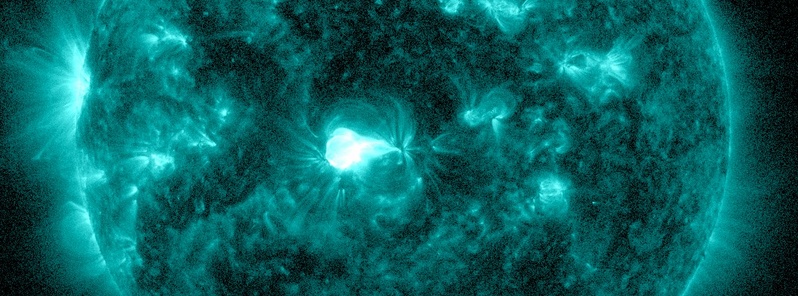
Image credit: SDO AIA 131
A moderate solar flare measuring M1.4 at its peak time erupted from Region 2268 on January 28, 2015. The event started at 04:21, peaked at 04:41 and ended at 04:55 UTC.
Coronal Mass Ejection (CME) was not produced.
Region 2268 ('beta-gamma') is currently the largest and most complex region on our side of the Sun. It is almost at the center of the disk, in a perfect geoeffective position, and is capable of producing strong eruptions on the Sun.
If it manages to produce a CME over the next few days, it will most likely be Earth-directed.


Sunspots
There are currently 6 numbered sunspot regions on the Earth side of the Sun.
Region 2268, the source of today's M1.4 flare, remains the largest and most complex region on the disk.
Region 2273 showed moderate growth yesterday, as well as regions 2271 and 2275.
Other regions on the disk remained relatively stable.
Old regions 2262 and 2260 are expected to return over the next two days.

Sunspots on January 28, 2015. Image credit: ESA PROBA2/SWAP
2268 – Beta-Gamma
2269 – Beta
2271 – Beta-Gamma
2272 – Beta
2273 – Beta
2275 – Beta-Gamma
Forecast
Solar activity is expected to be at low levels with a chance for isolated M-class (R1-R2, Minor-Moderate) flares and a slight chance for R3-Strong activity over the next three days (January 28 – 30).
The greater than 2 MeV electron flux at geosynchronous orbit is forecast to be at normal to moderate levels through the same period. The greater than 10 MeV proton flux is expected to remain at background levels (Below S1-Minor).
Solar wind parameters reflected slightly disturbed conditions during the last 24 hours (by 00:30 UTC today). IMF Bt was variable ranging from 1-13 nT while Bz ranged from +6 nT to -9 nT. Solar wind speeds gradually increased from approximately 365 km/s to a peak near 530 km/s. Phi angle was somewhat variable throughout the period but still remained predominately negative (towards).
Solar wind parameters are expected to continue to be disturbed and may show additional speed enhancements over the next three days with solar wind speeds possible in the 450 to 550 km/s range.
The geomagnetic field was quiet to unsettled during last 24 hours and is expected to remain like that through the rest of the UTC day. Quiet to active levels are anticipated on January 29 and 30 with a chance for G1-Minor storms on January 30 to continued influence from the southern crown polar coronal hole.

Teo Blašković founded The Watchers in 2011 and edited it until 2026, covering seismic and volcanic activity, extreme weather, space weather and near-Earth objects. Articles on this page are his archive.
Published in the last 24 hours
- High Risk of excessive rainfall covers Florida’s Space Coast as St. Johns River near Cocoa reaches 5.67 m
- Asteroid 2026 WJ to pass Earth at 1.7 lunar distances at 04:20 UTC on November 22, with 2026 WD following at 4.4 lunar distances on November 23
- Cyclone Akvan crossed the north Andhra Pradesh and south Odisha coasts close to Gopalpur on November 20 with 70-80 km/h winds gusting to 90, and has weakened into a deep depression
- A broad low over southeastern Florida and the northwestern Bahamas has a 30 percent chance of subtropical or tropical development within 48 hours and a 50 percent chance within 7 days, the National Hurricane Center says
