
Rare fallstreak hole cloud observed over Melbourne, Australia
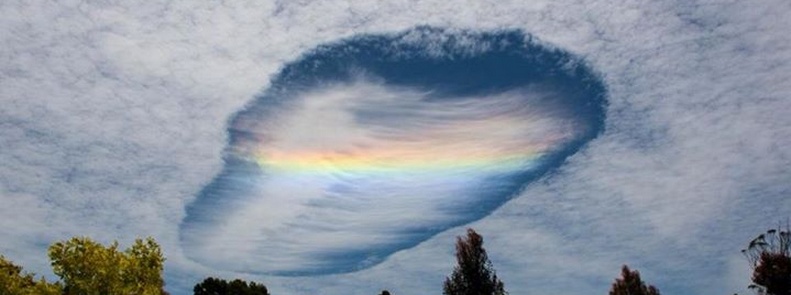
Image credit: TW
A rare fallstreak hole cloud was observed today over Melbourne, Australia, Meteo Europe team reports. Because of their rarity and unusual appearance, as well as very little exposure in media, fallstreak holes are often mistaken for or attributed to unidentified flying objects.
A fallstreak hole, also known as a hole punch cloud, punch hole cloud, skypunch, canal cloud or cloud hole, is a large circular or elliptical gap that can appear in cirrocumulus or altocumulus clouds. Such holes are formed when the water temperature in the clouds is below freezing but the water has not frozen yet due to the lack of ice nucleation particles.
When ice crystals do form it will set off a domino effect, due to the Bergeron process, causing the water droplets around the crystals to evaporate: this leaves a large, often circular, hole in the cloud.

Image copyright David Barton.
The following image is another example of this phenomenon observed on August 17, 2008 about 20 km south of Linz, Austria by H. Raab:

Image credit: H. Raab
Featured image courtesy of David Barton

Teo Blašković founded The Watchers in 2011 and edited it until 2026, covering seismic and volcanic activity, extreme weather, space weather and near-Earth objects. Articles on this page are his archive.
Published in the last 24 hours
- Northern lights are possible at high latitudes on November 17 and 18 as NOAA forecasts minor (G1) geomagnetic storms from coronal hole wind
- In February 2022, SpaceX launched 49 Starlink satellites into a solar storm so mild that forecasters rated it minor, and within days 38 of them had fallen back and burned up, because the storm had swollen the thin air they were flying through Epicenter
- On a Friday night in October 1992, a fireball over the eastern US was filmed by fans at high school football games before it punched through the trunk of a teenager’s $400 Chevy Malibu in Peekskill, New York, and she sold the wrecked car for $10,000 Epicenter
- Green Lake, Hawaii's largest freshwater lake, was gone by the afternoon of June 2, 2018, after lava from Kilauea filled its basin. The water was about 20 feet deep, not the 200 feet often claimed. Epicenter
