
Noctilucent clouds season has begun in southern hemisphere
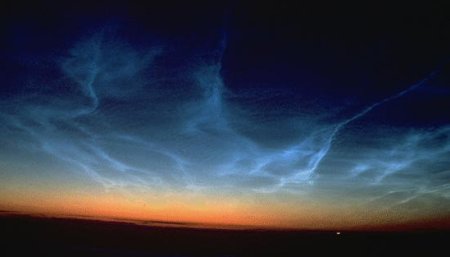
Featured image: Noctilucent clouds over Finland. The orange hues near the horizon are ordinary sunset colors, notes Gary Thomas. NLCs, on the other hand, are usually "luminous blue-white or sometimes just pale white," he says. Image credit: Pekka Parviainen
The season of noctilucent, "night-shining", clouds has begun in the southern hemisphere and NASA's AIM spacecraft is monitoring a vast bank of rippling electric-blue NLCs blanketing almost all of Antarctica.
Noctilucent clouds (electric-blue clouds or NLCs) were first seen in 1885, about two years after the powerful eruption of Krakatoa in Indonesia, which hurled plumes of ash as high as 80 km into Earth's atmosphere but NLCs have intensified over the last few years and some researchers see this is a sign of climate change.
A century ago the clouds were confined to latitudes above 50o; you had to go to places like Scandinavia, Russia and Britain to see them. In recent years they have been sighted as far south as Utah and Colorado… (Source)
"When methane makes its way into the upper atmosphere, it is oxidized by a complex series of reactions to form water vapor," explains Hampton University Professor James Russell, the principal investigator of AIM." This extra water vapor is then available to grow ice crystals for NLCs."
The following movie shows last two weeks of AIM data. It chronicles the onset of the clouds in late November and their rapid spread into December 2013.

Click here to set the scene in motion. AIM spacecraft via SpaceWeather
The 2013 northern hemisphere noctilucent season was remarkable because it started a week earlier than in any other season AIM has observed, said Cora Randall, at the Laboratory of Atmospheric and Space Physics at the University of Colorado. This is quite possibly earlier than ever before, she added. (June 7, 2013 – NASA AIM)
The early start is extra-puzzling because of the solar cycle. Researchers have long known that NLCs tend to peak during solar minimum and bottom-out during solar maximum – a fairly strong anti-correlation. "If anything, we would have expected a later start this year because the solar cycle is near its maximum," Randall says. "So much for expectations."
Noctilucent clouds and aurora over Scotland on camera
The following video was recorded early August 2013:

Video courtesy of Maciej Winiarczyk

Teo Blašković founded The Watchers in 2011 and edited it until 2026, covering seismic and volcanic activity, extreme weather, space weather and near-Earth objects. Articles on this page are his archive.
Published in the last 24 hours
- A Virginia park ranger was struck by lightning seven times and lived, even though three of the strikes set his hair on fire Epicenter
- The hole in the ozone layer over Antarctica was about twice the size of the US this year, and scientists say it would have been bigger still if ozone-eating chemicals were at their 2000 levels Epicenter


I concur completely, Lynn. Well done, and well said.
Glory to God who created it all!
Love looking at the God's creation. It always amazes me. That was beautiful so was the music. Thanks for all your time and expertise to share this with us.