• Historic solar wind event reveals Alfvén wings in Earth’s magnetosphere

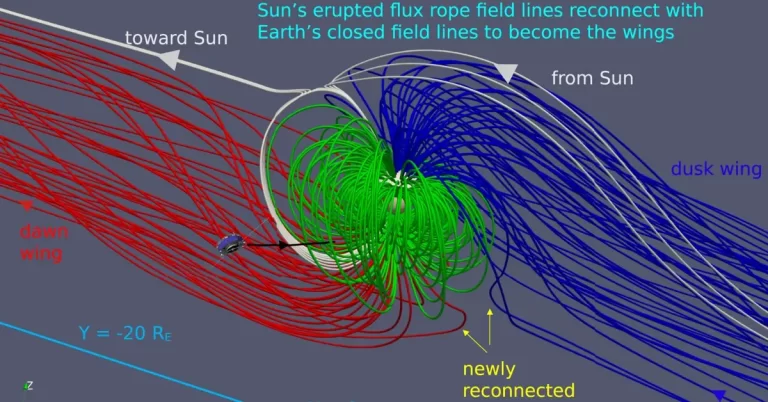
    New research published in Geophysical Research Letters reveals an unprecedented solar wind event observed by NASA’s Magnetospheric Multiscale (MMS) mission on April 24, 2023, when a massive coronal mass ejection (CME), with a low plasma beta of 0.01, caused Earth’s magnetosphere to lose its typical tail and form Alfvén wings. This event, lasting about two hours, provides new insights into space weather processes and the interaction between CME plasma and Earth’s magnetic field.

  • Two-step energy transfer in Earth’s magnetosphere

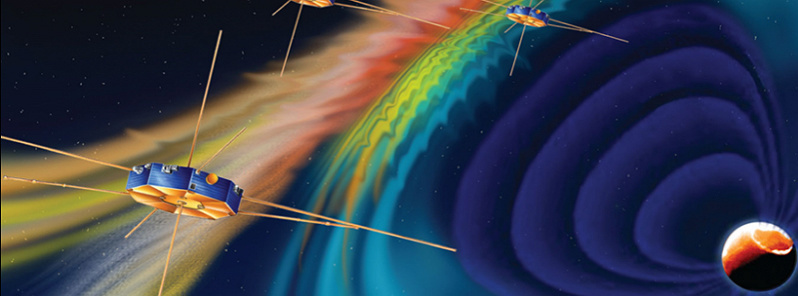
    Scientists have obtained in situ measurements of Earth's magnetosphere, demonstrating a phenomenon that's long been thought to happen but not yet directly been shown: energy is transferred from hydrogen ions to plasma waves, and then from the waves to helium…

  • Jets of ionospheric cold plasma discovered at the magnetopause

    The Sun and Earth both produce powerful magnetic fields, and their intersection develops a complex system of physics that determines the space weather experienced by our planet. The solar wind – a constant stream of charged particles (plasma) emitted from the Sun -…

  • Flying through explosive magnetic phenomenon to understand space weather

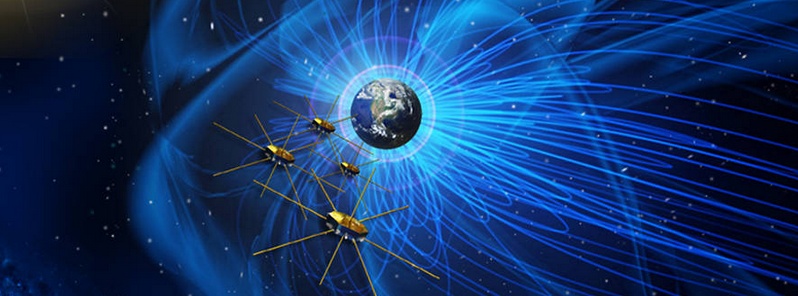
    Analyzing data obtained by four identical spacecraft that passed directly through a magnetic reconnection site on the boundary between the solar wind and Earth's magnetosphere, researchers have observed how this explosive physical process converts stored…