
Hurricane Katrina swept eight aquarium dolphins out to sea in Mississippi in 2005, and 12 days later they were found still swimming together
Eight bottlenose dolphins were swept from the Marine Life Oceanarium in Gulfport, Mississippi, when Hurricane Katrina’s storm surge overran their enclosure on August 29, 2005. Twelve days later, rescuers found all eight alive near Gulfport Harbor and still together as a social group in Mississippi Sound. Their staged recovery continued through September 20, when the final four were brought to safety.
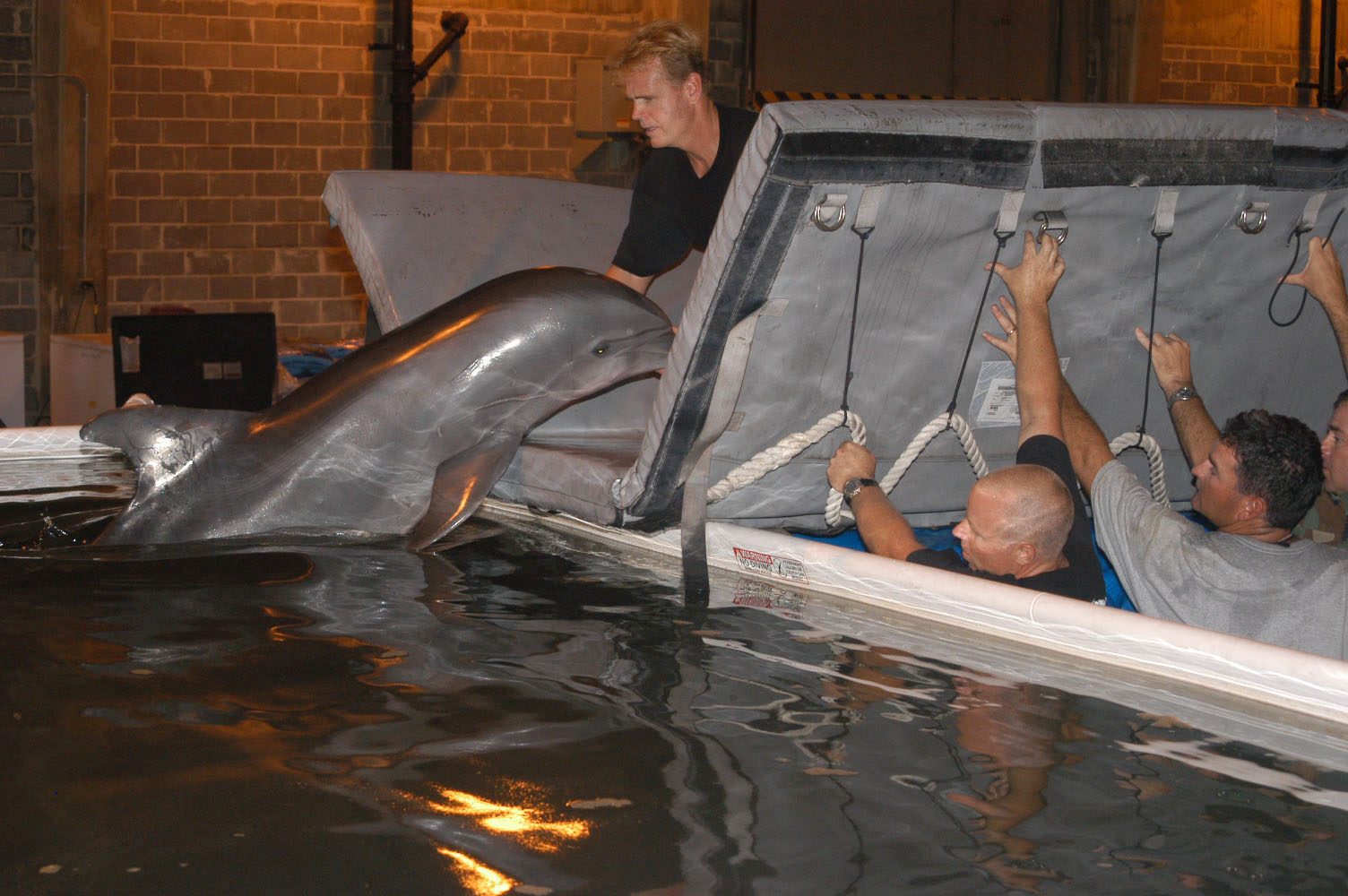
Kelly is transferred into a temporary saltwater pool at Naval Construction Battalion Center Gulfport on September 17, 2005. Credit: Petty Officer 3rd Class Chris Gethings, U.S. Navy (VIRIN 050917-N-0793G-018). Public domain.
Marine Life Oceanarium housed 14 bottlenose dolphins when Hurricane Katrina approached the Mississippi Gulf Coast. Six were evacuated inland to local hotel swimming pools, while the remaining eight were placed in the facility’s above-ground main pool for the storm. Five normally lived in that pool and three others were moved there from an in-ground bay pool during hurricane preparations.
The eight were Jackie, Kelly, Michelle, Jill, Tamara, Toni, Noah and Elijah. Jackie, Kelly, Michelle, Jill and Tamara were wild-caught dolphins that had spent most of their lives under human care, while Toni, Noah and Elijah were captive-born. The six females were adults; Noah and Elijah were juveniles.

Katrina made landfall on August 29, 2005, and the combination of storm surge and waves rose high enough to sweep the dolphins from the main pool into Mississippi Sound. The facility was heavily damaged, and the animals disappeared into coastal waters outside the managed environment in which they had been living.
Conditions along the devastated coast prevented an immediate search. Trainers could not begin looking for the dolphins until 12 days after Katrina’s landfall. A boat and helicopter began the search on September 10 with trainers who knew the animals individually and could identify them from the air and water.
Within the first 30 minutes, the helicopter crew sighted a small group of dolphins just outside Gulfport Harbor. Trainers directed the rescue boat toward them and gave the two-whistle recall signal used in their training. Michelle surfaced and stationed at the bow first. The others followed until all eight dolphins had approached the boat.

The dolphins were found grouped approximately 900 m (2 950 feet) from the location of their former pool. All eight were accounted for during the initial search, and on subsequent days they continued approaching the rescue boat as a group while trainers supplied food, examined them and provided medical treatment.
Their cohesion later became the subject of a peer-reviewed behavioral study. Bottlenose dolphins live in what biologists describe as a fission-fusion society, in which individuals separate into smaller groups and reunite while maintaining longer-term relationships within a larger social community. Katrina abruptly moved this particular group from a managed environment into open coastal water.
Researchers considered Jill, Kelly and Jackie, the three most experienced adult females, as possible stabilizing members of the group. Jill and Kelly repeatedly remained about 4–5 m (13–16 feet) behind the other dolphins during feeding sessions. Wild dolphins approached the group, but researchers did not observe them passing Jill and Kelly and entering the feeding formation.
The positioning of Jill and Kelly was interpreted as possible defensive or caregiving behavior rather than proof that either dolphin controlled the group. The observations therefore do not establish the stronger claim sometimes made in later accounts that Jill alone was responsible for keeping all eight dolphins together.
Jill nevertheless had an unusual behavioral history. She had no biological offspring of her own, but trainers had previously observed her providing allomaternal care to calves. On separate occasions she helped abandoned calves reach the surface to breathe, remained with them until their mothers returned, and was also reported to have spontaneously lactated while caring for another female’s calf.
Noah and Elijah supplied another social observation. The two juvenile males were found side by side whenever researchers observed them. When the dolphins responded to trainers, the larger group sometimes milled within an area roughly 100 m (330 feet) across, but Noah and Elijah consistently remained together.

NOAA Fisheries treated the animals operationally as captive dolphins dependent on human care. After locating them on September 10, NOAA marine mammal biologists and aquarium trainers began supplying food and medicine while preparing a staged recovery rather than trying to remove the entire group at once.
The animals were scratched and marked from their time outside the facility, and the recovery team had to work in coastal water affected by Katrina debris. Trainers continued returning to the group, allowing them to maintain contact with the dolphins while preparing a way to bring them ashore safely.
Rescuers relied on behaviors the dolphins already knew through training. Two large floating mats were tied together and anchored to the seabed so trainers could feed and work with the animals. The dolphins were asked to beach voluntarily onto the mats on command and could then be transferred one at a time onto the rescue boat.

The scientific paper’s narrative states that Jackie and Toni were recovered first on September 15 because trainers were particularly concerned about their condition. Jackie was very thin and having difficulty maintaining her station in the current, while Toni had the greatest number of wounds on her body. Both were taken by boat to inland hotel pools.
Noah was recovered on September 16. Trainers had also intended to collect Elijah, but he did not cooperate with the voluntary beaching behavior after Noah was removed. Kelly was recovered the following day, September 17, leaving Jill, Elijah, Michelle and Tamara in Mississippi Sound.


U.S. Navy Marine Mammal Program personnel from San Diego established temporary above-ground saltwater pools at Naval Construction Battalion Center Gulfport and supplied filtration equipment needed to care for the rescued animals. By September 17, Kelly, Noah, Jackie and Toni were together at the Navy facility.

The remaining four were not found during searches on September 18 and 19. On September 20, several boats located them near Biloxi, approximately 13 km (8.1 miles) from the area where trainers had previously been working with them and about 10 m (33 feet) offshore. Researchers said the reason for the dolphins’ move was unknown.
Tamara responded first and was recovered. Michelle was collected next, followed by Jill. Trainers had hoped Jill would remain near Elijah and keep him away from the rescue net, but as Jill was brought onto the mat Elijah became entangled. The waiting team removed him from the water, and the scientific account reported only minor scratches.
The September 20 operation completed the recovery of all eight dolphins, ten days after the group was first located and roughly three weeks after Katrina swept them from the aquarium. NOAA said the dolphins had remained together after the storm while surviving injuries, predators and the loss of their normal captive environment.
The operation involved NOAA Fisheries, Marine Life personnel and several government and marine-mammal partners. NOAA identified the U.S. Navy, Air National Guard, Coast Guard, U.S. Department of Agriculture, Gulf World Marine Park, Florida Fish and Wildlife Conservation Commission and Harbor Branch Oceanographic Institute among the organizations involved.
The successful rescue became the most widely remembered part of the episode, but the decision to leave eight dolphins at the waterfront facility remained disputed. Six other dolphins had been moved to hotel swimming pools before Katrina, and a later Sun Herald investigation documented criticism within the marine-mammal industry over why the remaining animals were allowed to ride out the hurricane at Marine Life.
Marine Life president Moby Solangi said there was no place to move every dolphin and argued that moving mothers and young animals carried risks of its own. The investigation also documented earlier hurricane evacuation practices at the facility and a dispute after Katrina between Solangi and Marine Life owner Don Jacobs.
Years of litigation followed the destruction of Marine Life. The case was sealed and eventually settled on undisclosed terms, leaving no public judicial finding that resolves the disagreement over the decisions made before Katrina.
Marine Life Oceanarium never reopened. Atlantis Paradise Island was selected in December 2005 as a permanent home for dolphins and sea lions displaced by Katrina. The Katrina dolphins began arriving at a harbor-side acclimation facility in the Bahamas on January 6, 2006, and Dolphin Cay opened the following year.

The eight dolphins had been assembled into that exact social grouping only hours before Katrina forced them into Mississippi Sound. Researchers later reported that the group remained socially cohesive for more than 17 days despite the abrupt transition from captivity to open coastal water and the gradual removal of individual animals during the rescue.
The observations offer a rare record of established dolphin relationships persisting through a major environmental disruption, but they were opportunistic rather than part of a controlled experiment. The researchers could document where the dolphins positioned themselves, which animals remained close together and how the group responded to trainers; they could not establish a single mechanism that caused all eight animals to remain together.
The strongest evidence therefore supports a narrower conclusion than some later retellings. All eight dolphins were found together 12 days after Katrina swept them from Marine Life Oceanarium, and they repeatedly returned to trainers as a group during the rescue. Jill, Kelly, Jackie and the group’s other established social relationships provide possible explanations for that cohesion, but the available observations do not establish that one dolphin alone kept the group together.
References:
1 Hoffland, T., Yeater, D. B., Kuczaj II, S. A., & Solangi, M. (2017). Importance of social relationships in a group of bottlenose dolphins (Tursiops truncatus) during a natural disaster. Aquatic Mammals, 43(4), 391–397. DOI: 10.1578/AM.43.4.2017.391
2 NOAA Fisheries Service Rescues The Last Four Trained Dolphins Washed Into Mississippi Sound After Hurricane Katrina – National Oceanic and Atmospheric Administration, archived by ScienceDaily – September 22, 2005
3 The untold story of Mississippi dolphins left to ride out Katrina in tanks on the Gulf – Sun Herald – August 22, 2015 (updated August 28, 2020)
4 The Dolphin Cay Story – Atlantis Paradise Island – accessed November 12, 2026

I’m a science journalist and researcher at The Watchers, contributing to the Epicenter edition, where I cover peer-reviewed scientific research and emerging discoveries across Earth and space sciences. With a background in astronomy and a passion for environmental science, I’ve worked in shark and coral conservation in Fiji, conducting reef and shark-behavior research, contributing to mangrove restoration, and earning PADI Open Water and Coral Reef Certifications. I bring a blend of scientific rigor and storytelling to illuminate the discoveries shaping our planet and beyond.
Published in the last 24 hours
- Antarctic moss began growing again after at least 1,530 years frozen in permafrost Epicenter
- In April 2014, golden-winged warblers in the mountains of Tennessee, songbirds weighing about as much as four dimes, fled their breeding grounds a day or two before a tornado outbreak and flew hundreds of miles south, while the scientists tracking them sheltered in a Waffle House Epicenter
- After record Nordic heatwave, Swedish researchers to recreate indoor heat to study older adults Epicenter
- San Juan River cuts through 300-million-year-old rocks while retaining its winding course in Utah Epicenter
