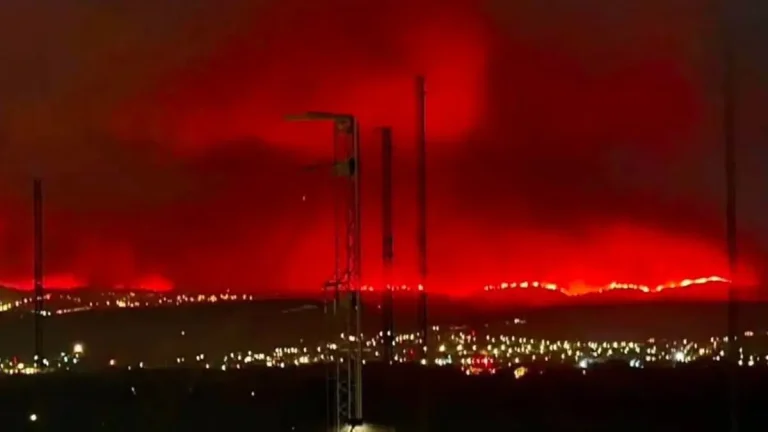
Videos show people fleeing as Mount Etna erupts, Italy
Footage captured on June 2, 2025, shows people fleeing as an eruption at Mount Etna’s Southeast Crater produces pyroclastic flow and an ash plume up to 6.5 km (21 325 feet).
I'm a dedicated researcher, journalist, and editor at The Watchers. With over 20 years of experience in the media industry, I specialize in hard science news, focusing on extreme weather, seismic and volcanic activity, space weather, and astronomy, including near-Earth objects and planetary defense strategies. You can reach me at teo /at/ watchers.news.

Footage captured on June 2, 2025, shows people fleeing as an eruption at Mount Etna’s Southeast Crater produces pyroclastic flow and an ash plume up to 6.5 km (21 325 feet).

A sharp increase in volcanic tremor preceded a new Strombolian eruption at Mount Etna, Italy, early on June 2, 2025, with ash and SO2 clouds drifting southwest. The Aviation Color Code was raised to Red at 03:32 UTC and downgraded to Orange at 06:39 UTC.

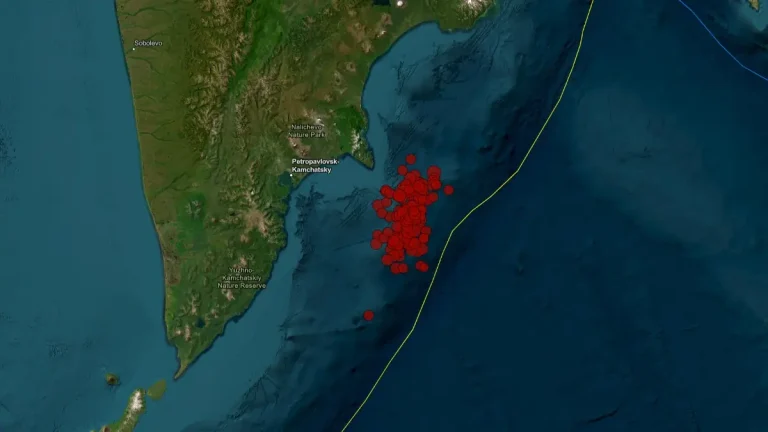
A strong and shallow earthquake registered by the JMA as M6.3 hit near the coast of Hokkaido, Japan, at 18:51 UTC on June 1, 2025 — 03:51 local time, June 2. USGS is reporting M6.0 at a depth of 31 km (19.2 miles).

A strong and shallow earthquake registered by the USGS as M6.2 hit the Kermadec Islands region at 22:26 UTC on May 31, 2025. The agency is reporting a depth of 10 km (6.2 miles). EMSC is reporting the same magnitude and depth. This is the third M6+ earthquake in the Kermadec Islands region in just 8 hours.

A shallow earthquake registered by the USGS as M6.0 hit the Kermadec Islands region at 21:21 UTC on May 31, 2025. The agency is reporting a depth of 10 km (6.2 miles). EMSC is reporting the same magnitude and depth.

An S1 – Minor solar radiation storm began at 17:00 UTC on May 31, 2025. The storm is linked to a long-duration M8.1 solar flare from Active Region 4100 at 00:05 UTC on May 31. Minor HF radio signal fades are being reported at high latitudes.

The U.S. Space Weather Prediction Center (SWPC) issued a G4 – Severe geomagnetic storm watch for June 2, 2025, following the eruption of a powerful, Earth-directed coronal mass ejection (CME) associated with a long-duration M8.1 solar flare from Active Region 4100. The CME is forecast to arrive at Earth late on June 1, with geomagnetic storm conditions expected to intensify through June 2.

A strong and shallow earthquake registered by the USGS as M6.1 hit Kermadec Islands region at 14:28 UTC on May 31, 2025. The agency is reporting a depth of 10 km (6.2 miles).

A strong and shallow earthquake registered by the USGS as M6.1 hit near the coast of Hokkaido, Japan, at 08:37 UTC (17:37 local time) on May 31, 2025. The agency is reporting a depth of 10 km (6.2 miles). JMA is reporting M6.1 at a depth of 20 km (12.4 miles).

A strong, long-duration solar flare registered as M8.1 erupted from Active Region 4100 at 00:05 UTC on May 31, 2025. The flare began at 23:31 UTC on May 30 and ended at 01:32 UTC on May 31. The eruption produced a significant coronal mass ejection (CME). Model forecasts indicate that the CME is Earth-directed and is expected to arrive on June 1.