
Heavy rain triggers urban flooding and transport disruption in Dubai, UAE
Flooding affected Dubai, United Arab Emirates, between March 23 and 27, 2026, after a multi-day period of thunderstorms and heavy rainfall impacted large parts of the country. Roads were inundated, vehicles became stranded, and transport operations experienced disruptions as rainfall totals exceeded 100 mm (3.9 inches) in parts of the UAE.
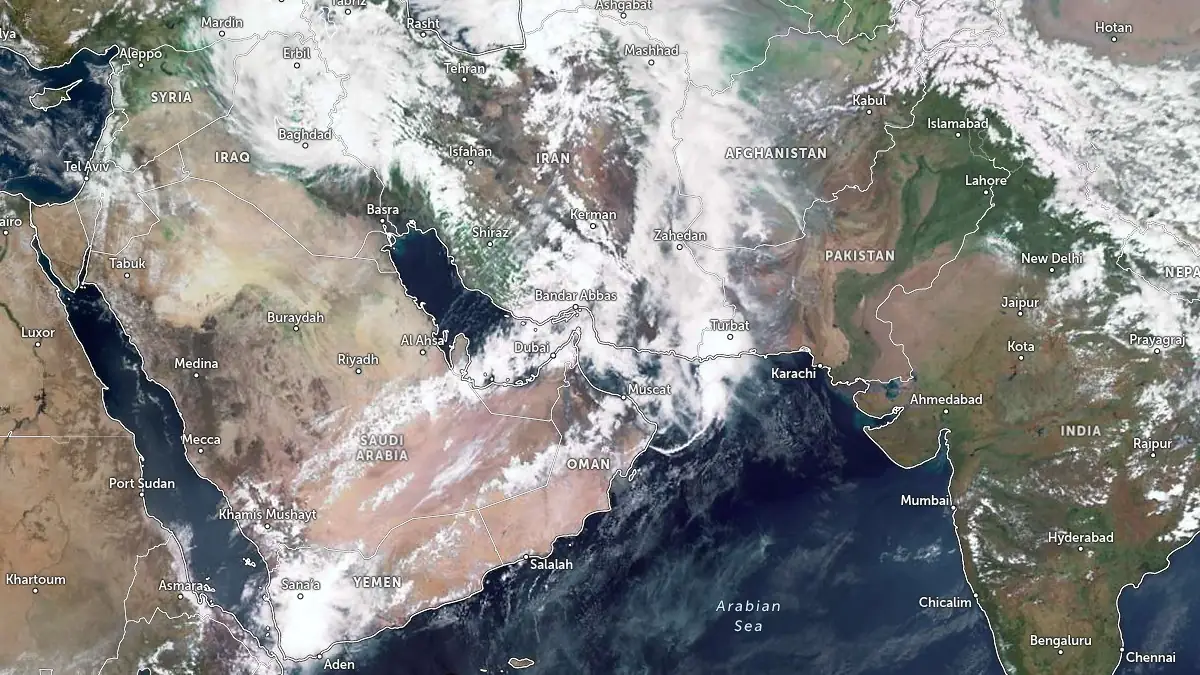
Image credit: EUMETSAT/Meteosat, Zoom Earth, The Watchers. Acquired at 08:15 UTC on March 27, 2026
Flooding was reported across Dubai after another burst of overnight rain into Friday, March 27, with water covering roads and slowing the morning commute. Local media reported stranded vehicles, pumping crews, and recovery vehicles on the streets before dawn, while weather-related disruption risk extended to flight schedules across the UAE.
On March 19, the National Emergency Crisis and Disaster Management Authority said rainfall of varying intensity, hail, and active winds were expected and that proactive measures were being prepared with relevant agencies.
Available rainfall data remain more precise at the UAE-wide scale than at the Dubai station scale. Several UAE stations recorded more than 100 mm (3.9 inches) during the event, while Jebel Yanas in northern UAE measured 244 mm (9.6 inches) — more than double the typical annual rainfall range of 60–100 mm (2.3–4 inches) for parts of the region.

Flooding in Dubai primarily affected roads and low-lying urban areas, where water accumulation led to traffic disruption and stranded vehicles. Authorities implemented drainage operations and response measures to manage water accumulation and maintain critical transport routes.
No fatalities or large-scale structural damage have been confirmed.

Teo Blašković founded The Watchers in 2011 and edited it until 2026, covering seismic and volcanic activity, extreme weather, space weather and near-Earth objects. Articles on this page are his archive.
Published in the last 24 hours
- In September 1859, a solar storm lit up the night sky so brightly that gold miners in the Rocky Mountains woke up after midnight and started cooking breakfast, convinced the aurora glowing over their camp was the sunrise Epicenter
- A patch of warm Pacific water that could become the strongest El Niño in more than 70 years sits thousands of miles from any American town, yet it is already the main reason NOAA expects a wetter winter across the South and a milder one across the North
- A 19-year-old Nebraska teacher reportedly tied her pupils together with twine and led them to safety through a blizzard in January 1888 Epicenter
- NASA built the Opportunity rover to last 90 days on Mars, and Martian winds helped keep it alive for nearly 15 years by blowing dust off its solar panels, until a planet-wide dust storm in 2018 blocked sunlight and silenced the rover Epicenter
