
Lava crosses Grindavík road for the third time, Iceland
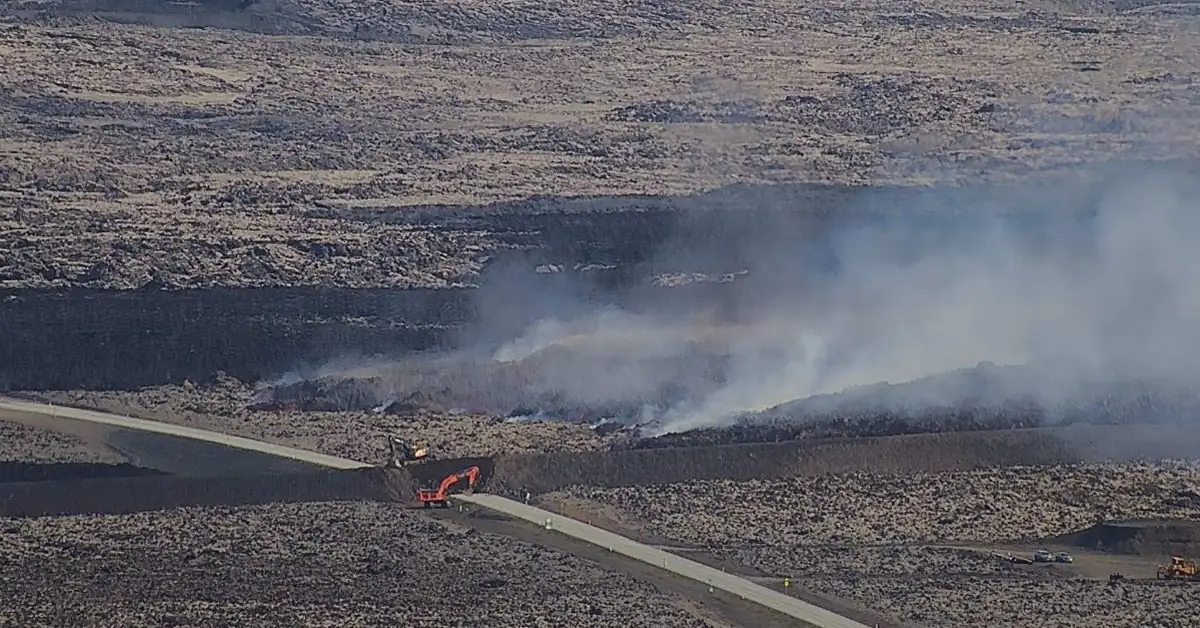
Image credit: IMO
The Icelandic Met Office reported on June 8, 2024, that Grindavíkurvegur road was covered by lava for the third time since the Sundhnúkur eruption began in November 2023. The lava, primarily flowing northwest, reached the road after breaching a protective barrier.
The Grindavíkurvegur road was once again covered by lava, marking the third instance since the Sundhnúkur volcanic eruption began in November 2023. The latest eruption, which started at 12:46 UTC on May 29, has persisted for eleven days, with significant lava flow observed primarily in the northwest direction.
Since June 4, a single active crater has been contributing to the lava flow. The lava has thickened near Sýlingarfell and has slowly extended north past Sýlingarfell and westward. During the night leading up to June 8, the lava flow increased towards Grindavíkurvegur road.
On the morning of June 8, efforts were made to close the gap in the protective barrier at Grindavíkurvegur.
However, by approximately 10:30 UTC, the lava tongue had reached the road just north of the barrier.
The Icelandic Met Office reported at 16:20 UTC that lava had also flowed along the barrier, thickening significantly and crumbling over it in places.
Although the speed of the lava flow decreased around noon, the front of the lava field advanced to about 800 m (2 624 feet) from the hot water pipelines and continued to move slowly towards them.
The current surge is considered to be over, but the situation remains under close observation. The possibility of another surge in the coming days cannot be ruled out.
References:
1 Grindavíkurvegur went under lava for the third time since the volcanic activity started at – IMO – June 8, 2024
2 Eruption starts north of Grindavik, lava fountains reach 50 m (164 feet) high, Iceland – The Watchers – May 29, 2024

Teo Blašković founded The Watchers in 2011 and edited it until 2026, covering seismic and volcanic activity, extreme weather, space weather and near-Earth objects. Articles on this page are his archive.
Published in the last 24 hours
- In September 1859, a solar storm lit up the night sky so brightly that gold miners in the Rocky Mountains woke up after midnight and started cooking breakfast, convinced the aurora glowing over their camp was the sunrise Epicenter
- A patch of warm Pacific water that could become the strongest El Niño in more than 70 years sits thousands of miles from any American town, yet it is already the main reason NOAA expects a wetter winter across the South and a milder one across the North
- A 19-year-old Nebraska teacher reportedly tied her pupils together with twine and led them to safety through a blizzard in January 1888 Epicenter
