
Large farside eruption creates impressive coronal mass ejection (CME)

Image credit: ESA/NASA SOHO LASCO C2 and LASCO C3, Helioviewer, TW
A powerful eruption took place on the farside of the Sun at around 22:23 UTC on February 15, 2022, creating an impressive coronal mass ejection (CME). This is one of the largest CMEs of Solar Cycle 25.
The source region for this event is beyond the east limb and therefore not likely to have an Earth-directed component.
This region is expected to turn into Earth-view in about a week.
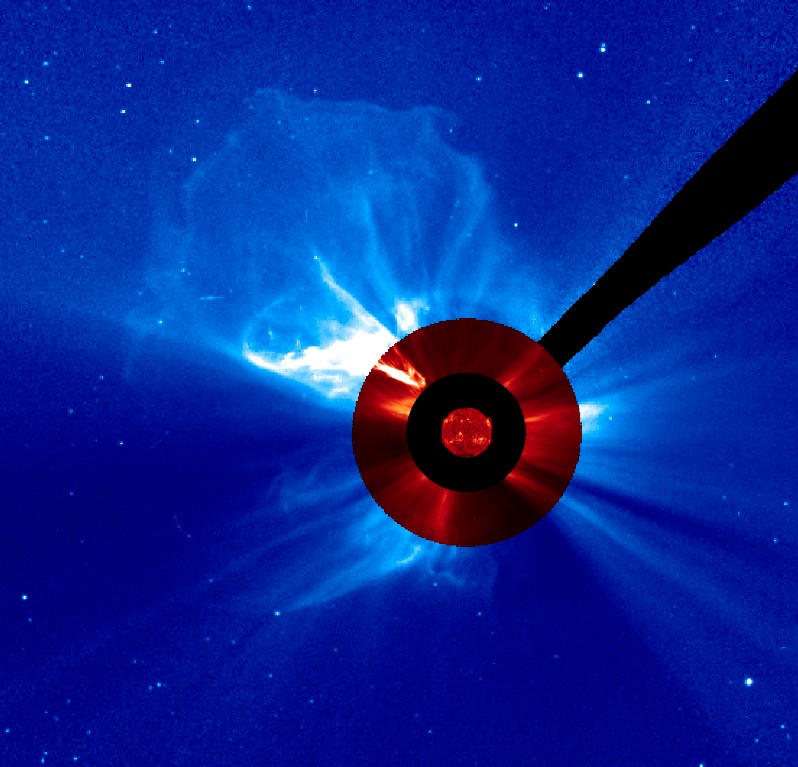
Image credit: ESA/NASA LASCO C2 and C3, Helioviewer, TW

Solar activity is likely to be low with a slight chance for an M-class (R1-R2, Minor-Moderate) flare through February 18, particularly from Region 2941. By February 18, solar activity should begin to return to low levels as Region 2941 rotates beyond the west limb.
The geomagnetic field was at quiet levels over the past 24 hours.
Mostly quiet conditions are expected through February 18 under an ambient solar wind regime.

Teo Blašković founded The Watchers in 2011 and edited it until 2026, covering seismic and volcanic activity, extreme weather, space weather and near-Earth objects. Articles on this page are his archive.
Published in the last 24 hours
- Second nationwide US flight halt since 9/11: how the November 13 FAA ground stop compares with September 2001 and January 2023 Epicenter
- FAA grounds all departing flights across the US after communications outage hits air traffic control centers nationwide
- In September 1859, a solar storm lit up the night sky so brightly that gold miners in the Rocky Mountains woke up after midnight and started cooking breakfast, convinced the aurora glowing over their camp was the sunrise Epicenter
- A patch of warm Pacific water that could become the strongest El Niño in more than 70 years sits thousands of miles from any American town, yet it is already the main reason NOAA expects a wetter winter across the South and a milder one across the North
