
Major solar flare reaching X1.1 peaked at 23:08 UTC
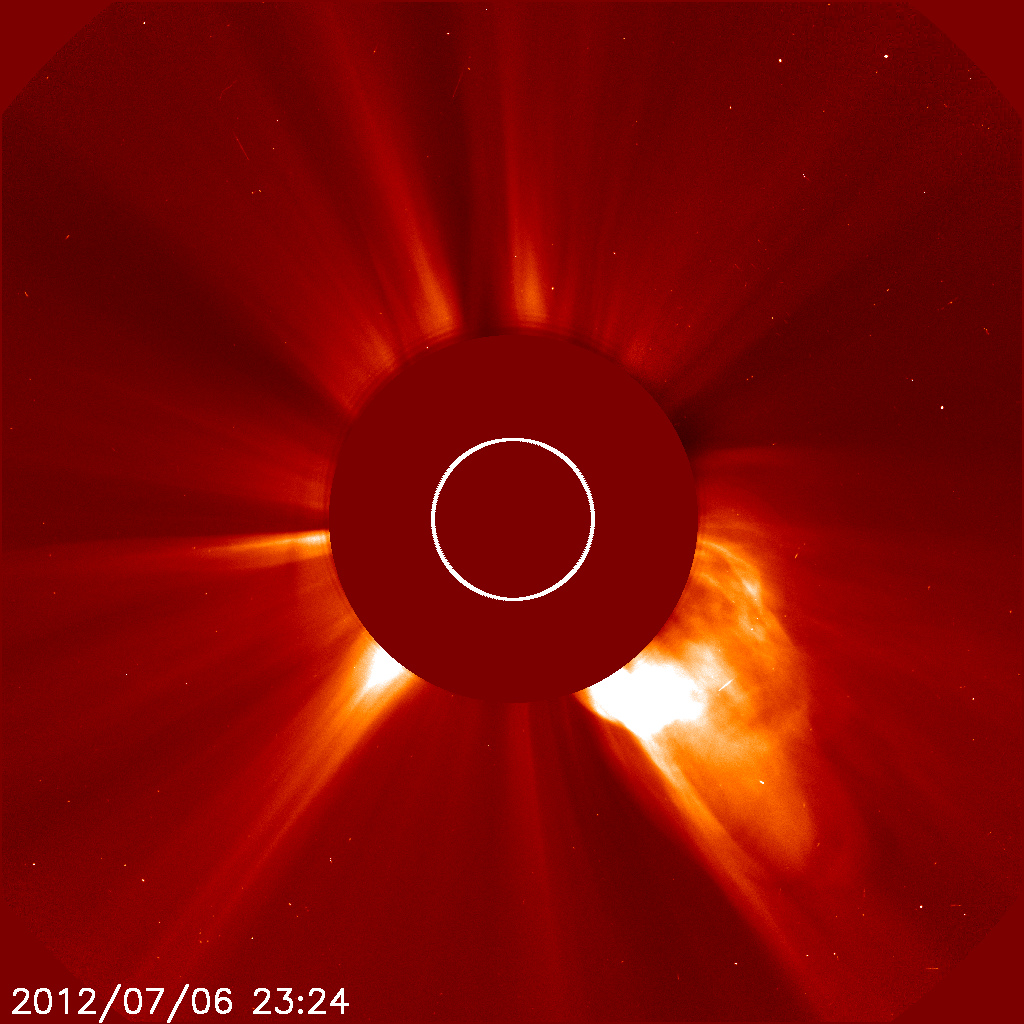
Image credit: TW
As we got used to M-class and waited a day to pass to report an overview of July 6, 2012 a major solar flare peaked. At 23:08 a major solar flare reaching X1.1 peaked. The flare was centered around Sunspot 1515.
Strong R3 radio blackout was reported.
Potential Impacts: Area of impact consists of large portions of the sunlit side of Earth, strongest at the sub-solar point. Radio – Wide area blackout of HF (high frequency) radio communication for about an hour.
A 10cm Radio Burst was reported. A 10cm radio burst indicates that the electromagnetic burst associated with a solar flare at the 10cm wavelength was double or greater than the initial 10cm radio background. This can be indicative of significant radio noise in association with a solar flare. This noise is generally short-lived but can cause interference for sensitive receivers including radar, GPS, and satellite communications.
There is 80% chance for an M-class event and 25% chance for X-class.
Earth is well-connected to the blast site by solar magnetic fields, a fusillade of protons accelerated by the explosion might soon reach our planet.
SUMMARY: X-Ray Event exceeded X1 (R3)
Space Weather Message Code: SUMX01
Serial Number: 80
Issue Time: 2012 Jul 06 2325 UTC
SUMMARY: X-ray Event exceeded X1
Begin Time: 2012 Jul 06 2301 UTC
Maximum Time: 2012 Jul 06 2308 UTC
End Time: 2012 Jul 06 2314 UTC
X-ray Class: X1.1
Location: S18W50
NOAA Scale: R3 – Strong
SUMMARY: 10cm Radio Burst
Begin Time: 2012 Jul 06 2304 UTC
Maximum Time: 2012 Jul 06 2306 UTC
End Time: 2012 Jul 06 2306 UTC
Duration: 2 minutes
Peak Flux: 520 sfu
Latest Penticton Noon Flux: 158 sfu


Meanwhile on the Sun, a new sunspot is emerging over the southeastern limb, and it appears to be a big one. NASA’s Solar Dynamics Observatory caught a first glimpse of the spot’s dark cores during the early hours of July 6th…


Teo Blašković founded The Watchers in 2011 and edited it until 2026, covering seismic and volcanic activity, extreme weather, space weather and near-Earth objects. Articles on this page are his archive.
Published in the last 24 hours
- High Risk of excessive rainfall covers Florida’s Space Coast as St. Johns River near Cocoa reaches 5.67 m
- Four small asteroids will pass close to Earth from November 21 to 23
- Cyclone Akvan weakens after landfall near Gopalpur; more than 300 000 evacuated in Odisha, India
- A broad low over southeastern Florida and the northwestern Bahamas has a 30 percent chance of subtropical or tropical development within 48 hours and a 50 percent chance within 7 days, the National Hurricane Center says

[…] The Watchers – Major solar flare reaching X1.1 peaked at 23:08 UTC […]