I’m a science journalist and researcher at The Watchers, contributing to the Epicenter edition, where I cover peer-reviewed scientific research and emerging discoveries across Earth and space sciences. With a background in astronomy and a passion for environmental science, I’ve worked in shark and coral conservation in Fiji, conducting reef and shark-behavior research, contributing to mangrove restoration, and earning PADI Open Water and Coral Reef Certifications. I bring a blend of scientific rigor and storytelling to illuminate the discoveries shaping our planet and beyond.

  • Lyrid meteor shower to light up night sky in April 2025

    The Lyrid meteor shower, caused by debris from Comet Thatcher, will peak from April 21 to April 22, 2025, with an expected rate of 10–15 meteors per hour. It will be best visible in the Northern Hemisphere, and rare surges and fireballs may occur under favorable conditions,

  • M5.2 San Diego earthquake linked to Elsinore Fault renews concerns over major seismic risk in Southern California

    M5.2 earthquake that struck San Diego County near Julian on April 14, 2025, occurred along the Elsinore Fault Zone, a major strike-slip fault in Southern California capable of producing earthquakes up to magnitude 7.8. The fault runs near densely populated areas including Los Angeles, Long Beach, and Riverside, and its long period of limited activity may indicate an increased potential for a significant seismic event, according to recent research.

  • Two dead after landslide buries a house in Dagua, Colombia

    A landslide triggered by heavy rainfall hit the municipality of Dagua, Valle del Cauca Department, Colombia, on April 13, 2025, killing two people after burying their home. The incident took place along the Cali-Loboguerrero road, prompting the preventive evacuation of three nearby homes.

  • Supermassive black hole Ansky awakens with record-breaking X-ray flares

    Previously dormant supermassive black hole Ansky in galaxy SDSS1335+0728, approximately 300 million light-years away in Virgo, started emitting exceptional X-ray flares in late 2019. These quasiperiodic eruptions last 10 times longer, shine 10 times brighter, and release 100 times more energy than typical black hole bursts. ESA’s XMM-Newton and NASA telescopes have recorded 165 such events since February 2024.

  • 165 dead as severe flooding and landslides hit Kinshasa, DR Congo

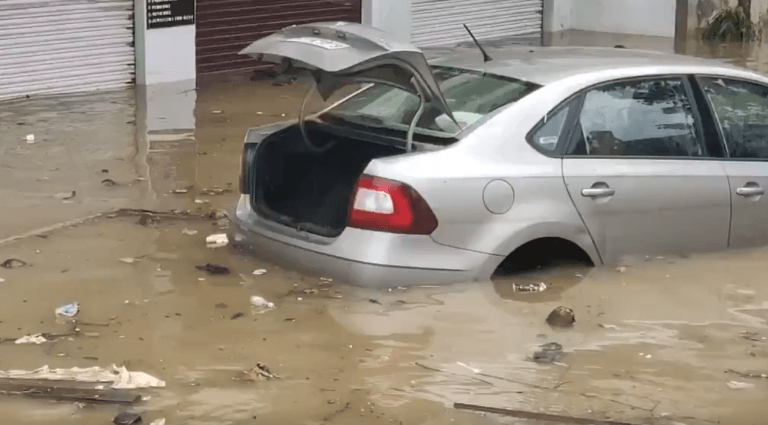
    Severe flooding and landslides in Kinshasa, the Democratic Republic of Congo, between April 4 and 11, 2025, have resulted in at least 165 deaths, 28 injuries, and the displacement of more than 7 000 people. Over 60 000 residents face widespread infrastructure damage and loss of access to basic services.

  • AI-powered monitoring detected over 50 000 earthquakes during intense seismic crisis in Santorini, Greece

    Researchers at the 10th Delphi Economic Forum on April 13, 2025, revealed that the use of advanced machine learning technology enabled them to detect over 50 000 earthquakes in Santorini, some of which occurred before the intense earthquake swarm in February 2025. This early detection enhanced earthquake forecasting and improved warning procedures during the crisis.

  • More than 5 000 cattle dead in Bolivia’s Beni region as severe flooding causes over $34 million in livestock losses

    Severe flooding in Bolivia’s Beni region has caused the death of more than 5 000 cattle, with losses in the livestock sector exceeding USD 34 million. The flooding, triggered by intense rainfall since early 2025, has submerged large areas of grassland, resulting in cattle deaths due to exhaustion and inadequate food access.

  • Rare April snowfall blankets Mount Teide as Storm Olivier impacts Canary Islands

    Storm Olivier brought a rare April snowfall to Mount Teide, the highest peak in Tenerife and all of Spain, on Thursday, April 10, 2025. The event was driven by a sharp drop in temperatures at higher elevations, allowing snow to accumulate on the summit. Wind gusts associated with the storm exceeded 90 km/h (56 mph), creating hazardous conditions across Teide National Park, while intense rainfall at lower elevations forced the closure of multiple recreational areas and trails.