I'm a dedicated researcher, journalist, and editor at The Watchers. With over 20 years of experience in the media industry, I specialize in hard science news, focusing on extreme weather, seismic and volcanic activity, space weather, and astronomy, including near-Earth objects and planetary defense strategies. You can reach me at teo /at/ watchers.news.

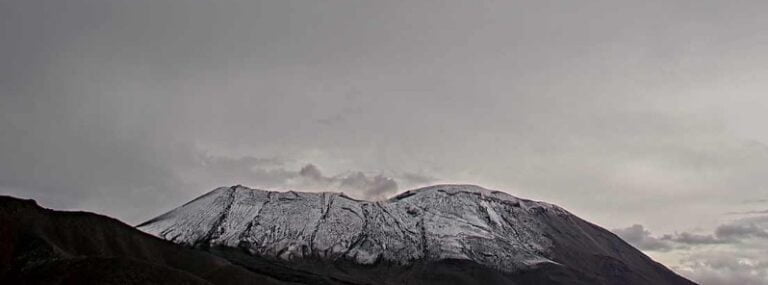
  • Increased seismicity at Lascar volcano, Alert Level raised to Orange, Chile

    Seismic activity around Chile’s Lascar volcano has increased over the past 2 days, causing Sernageomin to raise its Alert Level to Orange. The security perimeter around the crater was expanded to 10 km (6.2 miles), with the community urged to avoid unnecessary exposure to potential dangers. The seismicity is primarily linked to fluid dynamics within the volcanic system, which could be a result of the destabilization of a remnant magmatic body. This activity could lead to explosive events, potentially causing ashfall in the area.

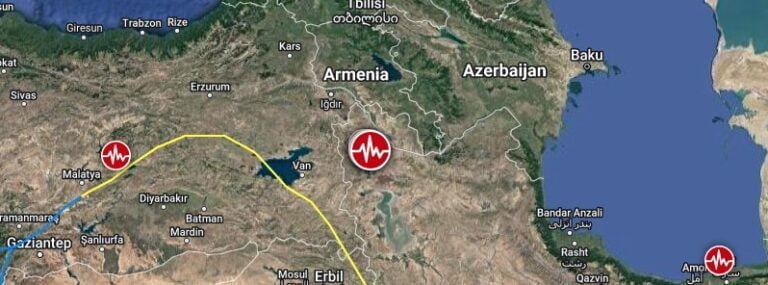
  • Shallow M5.9 earthquake hits northern Iran

    A strong and shallow earthquake registered by the USGS as M5.9 hit Turkey – Iran border region at 18:14 UTC on January 18, 2023. The agency is reporting a depth of 10 km (6.2 miles). EMSC is reporting M5.9 at a depth of 15 km (9 miles). The same region was hit by M5.8 earthquake on January 18, injuring at least 70 people and damaging more than 300 homes.

  • Researchers identify small signals in the corona to improve solar flare predictions

    A team of scientists from NorthWest Research Associates (NWRA) have made a breakthrough discovery in the study of solar flares, using data from NASA’s Solar Dynamics Observatory (SDO). The researchers found small signals in the upper layers of the solar atmosphere, known as the corona, that can indicate which regions on the Sun are more likely to produce solar flares.

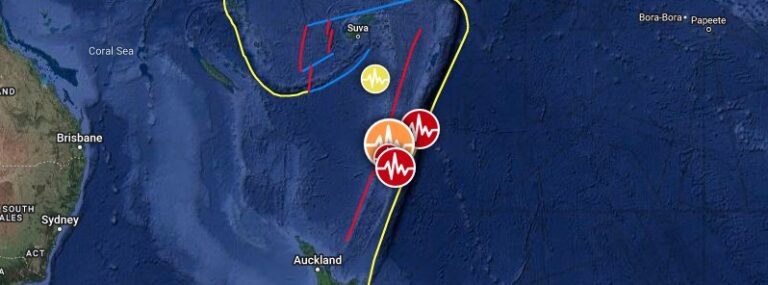
  • M6.0 earthquake hits Kermadec Islands

    A strong earthquake registered by the USGS as M6.0 hit the Kermadec Islands at 10:45 UTC on January 26, 2023. The agency is reporting a depth of 135.7 km (84.3 miles). EMSC is reporting M5.6 at a depth of 100 km (62 miles).

  • Decades-long growing rift in Brunt Ice Shelf finally breaks, creating new iceberg, Antarctica

    On January 22, 2023, a massive rift on the Brunt Ice Shelf in Antarctica finally gave way, resulting in the formation of a new iceberg measuring 1 550 km2 (~600 mi2). The U.S. National Ice Center has named it Iceberg A-81. The rift, spanning most of the Brunt Ice Shelf in Antarctica, appeared ready to spawn an iceberg in 2019, posing an uncertain future for scientific infrastructure and a human presence on the shelf that was first established in 1955 by the British Antarctic Survey (BAS).