
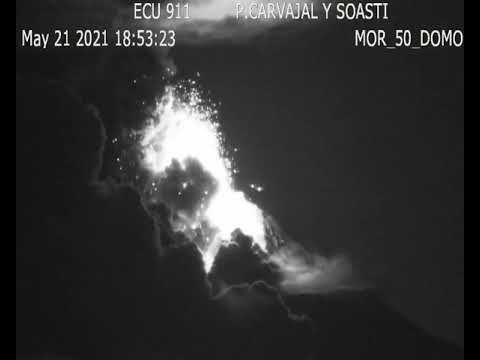
Strong eruption with large lava fountaining at Sangay volcano, Ecuador

Image credit: IGEPN
Volcanic activity at Sangay volcano, Ecuador increased significantly at 00:20 UTC on May 22, 2021, producing strong paroxysmal eruptive episode 500 – 1 000 m (1 640 – 3 300 feet) from the crater. The Aviation Color Code was raised to Red at 00:40 UTC and lowered back to Orange at 05:20.
Ash plume rose up to 9.1 km (30 000 feet) above sea level, drifting SE, W, and SW.
Slight ashfall was reported in the parishes of Alausí, Tixán, Sibambe, and very slight in Achupallas.


The seismic tremor started decreasing at 01:30 UTC.
Ash emissions ended at 02:30 UTC but IG warned slight ashfall is still possible in the provinces of Chimborazo, Bolívar, Los Ríos, Guayas, Cañar and Azuay.


Ash emission produced by Sangay volcano on May 21, 2021. Credit: Copernicus EU/Sentinel-2, TW
Geological summary
The isolated Sangay volcano, located east of the Andean crest, is the southernmost of Ecuador's volcanoes and its most active.
The steep-sided, glacier-covered, dominantly andesitic volcano grew within horseshoe-shaped calderas of two previous edifices, which were destroyed by collapse to the east, producing large debris avalanches that reached the Amazonian lowlands.
The modern edifice dates back to at least 14 000 years ago. It towers above the tropical jungle on the east side; on the other sides flat plains of ash have been sculpted by heavy rains into steep-walled canyons up to 600 m (1 979 feet) deep.
The earliest report of a historical eruption was in 1628. More or less continuous eruptions were reported from 1728 until 1916, and again from 1934 to the present.
The almost constant activity has caused frequent changes to the morphology of the summit crater complex. This volcano is located within the Sangay National Park, a UNESCO World Heritage property.

Teo Blašković founded The Watchers in 2011 and edited it until 2026, covering seismic and volcanic activity, extreme weather, space weather and near-Earth objects. Articles on this page are his archive.
Published in the last 24 hours
- High Risk of excessive rainfall covers Florida’s Space Coast as St. Johns River near Cocoa reaches 5.67 m
- Asteroid 2026 WJ to pass Earth at 1.7 lunar distances at 04:20 UTC on November 22, with 2026 WD following at 4.4 lunar distances on November 23
- Cyclone Akvan crossed the north Andhra Pradesh and south Odisha coasts close to Gopalpur on November 20 with 70-80 km/h winds gusting to 90, and has weakened into a deep depression
- A broad low over southeastern Florida and the northwestern Bahamas has a 30 percent chance of subtropical or tropical development within 48 hours and a 50 percent chance within 7 days, the National Hurricane Center says
