
Major eruption at Bezymianni volcano, ash to 15.2 km (50 000 feet), Aviation Color Code Red

Featured image: Eruption of Bezymianni volcano on December 20, 2017. Credit: Kamchatka Branch of the Geophysical Survey RAS
A major eruption started at Bezymianni volcano, Kamchatka, Russia at 03:41 UTC on December 20, 2017. According to Tokyo VAAC, volcanic ash plume is reaching 15.2 km (50 000 feet) above sea level and drifting NE. In terms of ash cloud height, this is the strongest eruption anywhere on the planet this year.
The activity at the volcano started gradually increasing on Monday, December 18. According to video data by RAS, hot avalanches at the southeastern flank of the lava dome were observed for several hours, probably as a result of the extrusive eruption.
This activity, accompanied by strong gas-steam activity continued through early December 20 when strong ash explosions started at 03:41 UTC. Ash plume rose to about 8 km (26 000 feet) a.s.l., forcing authorities to raise the Aviation Color Code from Orange to Red.
At 04:09 UTC, ash plume/cloud was extending 20 km (12 miles) NE of the crater. By 04:20 UTC, it was already 85 km (53 miles) NE of the crater.
"Strong ash explosions up to 15 km (49 000 feet) a.s.l. occur at this time," KVERT said 04:47 UTC. "Ongoing activity could affect international and low-flying aircraft," they warned.

Webcam located in Kozyrervsk, approximately 50 km (31 miles) west of Bezymianny volcano. Credit: Kamchatka Branch of the Geophysical Survey RAS
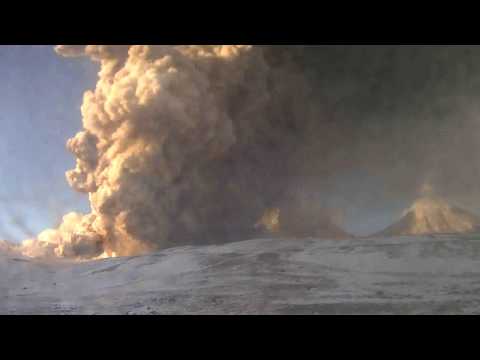
Webcam located in seismic station, approximately 7 km (4.3 miles) East of Bezymianny volcano. Credit: Kamchatka Branch of the Geophysical Survey RAS
The activity of the volcano decreased, KVERT said 10:59 UTC, lowering the Aviation Color Code back to Orange. Strong ash emission is no longer coming out of the volcano, but separate ash clouds continue drifting to the northeast. Gas-steam activity continues and and there is a danger of ash explosions up to to 10 km (32 800 feet) a.s.l., it said.
The last major explosive eruption at Bezymianny volcano started at 04:53 UTC on Friday, June 16, 2017. By 05:10 UTC, ash plume from the eruption reached an altitude of 12.2 km (40 000 feet) above sea level and a distance of 40 km (25 miles) NE.
Bezymianny is one the most active volcanoes in the world. It started erupting, for the first time in known history, in 1955. After six months, it produced a catastrophic eruption with the total volume of eruptive products over 3 km3.
The lava dome began to grow in the explosive caldera immediately after the catastrophe and still continues. At least 44 Vulcanian-type strong explosive eruptions of Bezymianny occurred between 1965 – 2012.
Geological summary
Prior to its noted 1955-56 eruption, Bezymianny had been considered extinct. The modern volcano, much smaller in size than its massive neighbors Kamen and Kliuchevskoi, was formed about 4700 years ago over a late-Pleistocene lava-dome complex and an ancestral edifice built about 11000 – 7000 years ago. Three periods of intensified activity have occurred during the past 3000 years.
The latest period, which was preceded by a 1000-year quiescence, began with the dramatic 1955-56 eruption. This eruption, similar to that of St. Helens in 1980, produced a large horseshoe-shaped crater that was formed by collapse of the summit and an associated lateral blast. Subsequent episodic but ongoing lava-dome growth, accompanied by intermittent explosive activity and pyroclastic flows, has largely filled the 1956 crater. (GVP)

Teo Blašković founded The Watchers in 2011 and edited it until 2026, covering seismic and volcanic activity, extreme weather, space weather and near-Earth objects. Articles on this page are his archive.
Published in the last 24 hours
- Second nationwide US flight halt since 9/11: how the November 13 FAA ground stop compares with September 2001 and January 2023 Epicenter
- FAA grounds all departing flights across the US after communications outage hits air traffic control centers nationwide
- In September 1859, a solar storm lit up the night sky so brightly that gold miners in the Rocky Mountains woke up after midnight and started cooking breakfast, convinced the aurora glowing over their camp was the sunrise Epicenter
- A patch of warm Pacific water that could become the strongest El Niño in more than 70 years sits thousands of miles from any American town, yet it is already the main reason NOAA expects a wetter winter across the South and a milder one across the North

Boeing and European Air Bus will not be able to fly thru volcanic ash eruption. Ash will clog jet engines.
This is just a sign of things to come in 2018 and beyond. You will see many major eruptions of bigger volcanoes in the near future. In fact, even now the number of undersea volcanoes that are erupting is enormous, but of course that does not suit the mainstream theory of climate change. Long live the science of crony capitalism
In which case we would observe global cooling. Please read and understand the science behind volcanic eruptions and their consequences before making ill-informed and prejudiced comments.