
Asteroid 2017 JQ1 flew past Earth at 0.44 LD
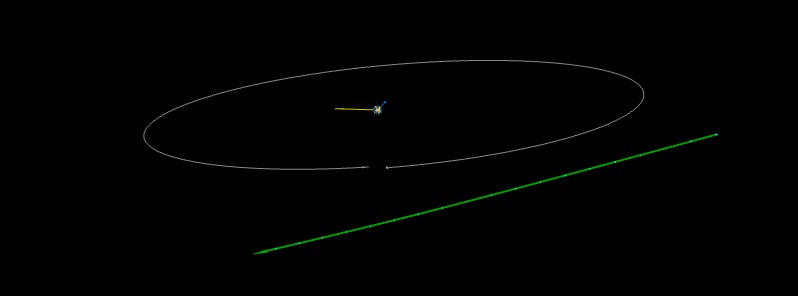
Featured image: The green line indicates the object's apparent motion relative to the Earth, and the bright green marks are the object's location at approximately one hour intervals. The Moon's orbit is gray. The blue arrow points in the direction of Earth's motion and the yellow arrow points toward the Sun. Credit: Minor Planet Center.
A newly discovered asteroid designated 2017 JQ1 flew past Earth at a distance of 0.44 LD (168 960 km / 104 986 miles) at 01:16 UTC on May 4, 2017. This is the 23rd known asteroid to fly past Earth within 1 lunar distance since January 9, 2017 (according to data available September 20, 2017).
2017 JQ1 belongs to the Apollo group of asteroids. It was first observed at Mt. Lemmon Survey on May 2, 2017. Its estimated size is between 2 and 8 m (6 – 26 feet) and it flew past Earth at a speed of 11.24 km/s (relative to the Earth). It won't pass this close to Earth for at least 180 years.
[ Ephemeris | Orbit Diagram | Orbital Elements | Physical Parameters | Close-Approach Data ]
As of May 1, 2017, there are 16 199 known near-Earth objects. 16 093 of them are asteroids, 8 774 belong to the Apollo group of asteroids.
Since January 1, 2017, we have discovered 686 near-Earth objects, all of them are asteroids. 23 of them, including 2017 JQ1, flew past Earth within 1 lunar distance.
Reference:
Asteroid 2017 JQ1 at Minor Planet Center, CNEOS

Teo Blašković founded The Watchers in 2011 and edited it until 2026, covering seismic and volcanic activity, extreme weather, space weather and near-Earth objects. Articles on this page are his archive.
Published in the last 24 hours
- CPC posts a slight risk of heavy rain from the Gulf Coast to the Northeast urban corridor November 25-29, and a moderate risk of West Coast wind and Sierra snow on November 25
- Florida's east coast faces a moderate flash flood risk Wednesday through Friday, with 4 to 8 inches of rain forecast and the St. Johns River near Cocoa already in major flood at 17.13 feet
- Cyclone Akvan to make landfall between Nellore and Visakhapatnam around noon on November 20, IMD forecasts 120-130 km/h winds gusting to 145
- Radio pulses every 7.9 minutes reveal binary with white dwarf and Sun-like star Epicenter
