
Asteroid 2017 HG4 flew past Earth at 0.61 LD
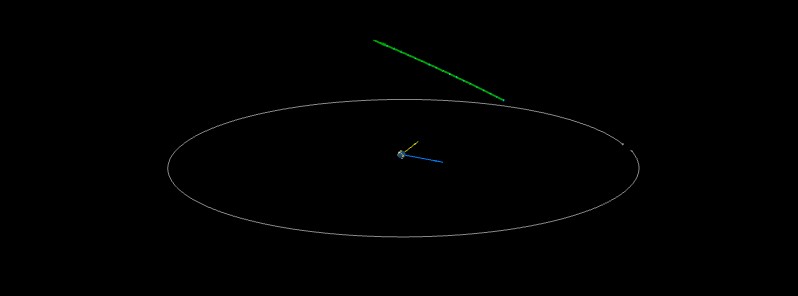
Featured image: The green line indicates the object's apparent motion relative to the Earth, and the bright green marks are the object's location at approximately one hour intervals. The Moon's orbit is gray. The blue arrow points in the direction of Earth's motion and the yellow arrow points toward the Sun. Credit: Minor Planet Center.
A near-Earth asteroid designated 2017 HG4 flew past Earth at a distance of 0.61 LD (~234 240 km / 145 550 miles) on April 22, 2017, four days before it was discovered. This makes it the 20th known asteroid to fly past Earth within 1 lunar distance since January 9, 2017 (according to data available September 20, 2017).
2017 HG4 belongs to the Aten group of asteroids, defined by having a semi-major axis of less than one astronomical unit, roughly an average distance from the Earth to the Sun. They also have an aphelion (furthest distance from the Sun) greater than 0.983 AU.
The estimated size of this object is between 7.8 and 17 m (25 – 55 feet) and it flew past us at a speed (relative to the Earth) of 4.02 km/s at 06:25 UTC. It was first observed at Pan-STARRS 1, Haleakala on April 26, 2017.
The next close approach of this object will take place at 10:17 UTC on April 16, 2021 (+/- 15:52 hours).
[ Ephemeris | Orbit Diagram | Orbital Elements | Physical Parameters | Close-Approach Data ]
As of April 24, 2017, there are 16 162 known near-Earth objects, 16 056 are asteroids. Of those, 1 176 belong to the Aten group of asteroids. Since the start of the year, we discovered 52 Atens.
2017 HG4 is the 20th known near-Earth asteroid to flyby Earth within 1 lunar distance (~384 000 km / 238 606 miles) since the start of the year, according to data available at CNEOS on September 20, 2017. Another near-Earth asteroid, designated 2017 HV2, flew past Earth at a distance of 0.33 LD (~126 720 km / 78 740 miles) a day after HG4, on April 23, 2017.
References:
Asteroid 2017 HG4 at Minor Planet Center, CNEOS

Teo Blašković founded The Watchers in 2011 and edited it until 2026, covering seismic and volcanic activity, extreme weather, space weather and near-Earth objects. Articles on this page are his archive.
Published in the last 24 hours
- Asteroid 2026 WA to pass Earth at 126,400 km, about a third of the Moon's distance, at 07:59 UTC on November 17
- Right about now, Voyager 1 is crossing a line no human-made object has ever reached, a full light-day from Earth, which means a message NASA sends tonight won't arrive until tomorrow night, and the spacecraft's answer won't make it home until the night after that
- G1 geomagnetic storm watch remains in effect as NOAA forecasts Kp 4.67 late on November 17 and early on November 18
- Atmospheric river brings moderate risk of heavy rain, mountain snow and high winds to northern California and southwest Oregon on November 24-25
