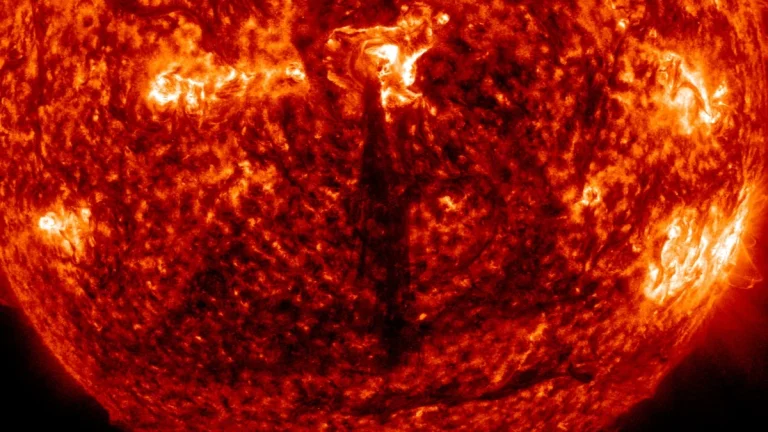
• Asymmetric halo CME following April 1 filament eruption forecast to deliver a glancing blow on April 4

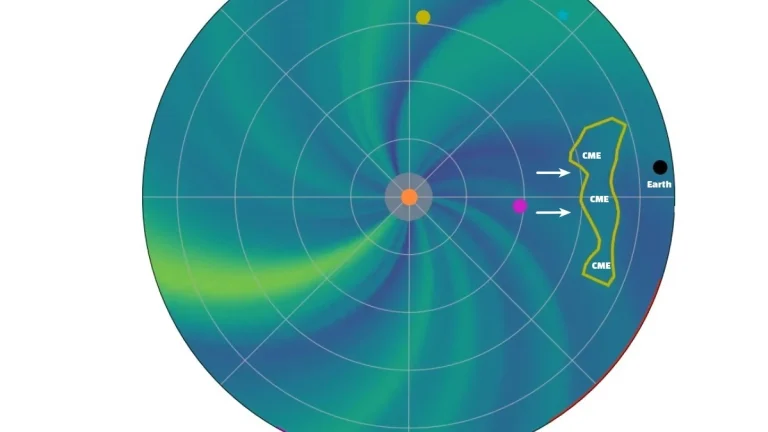
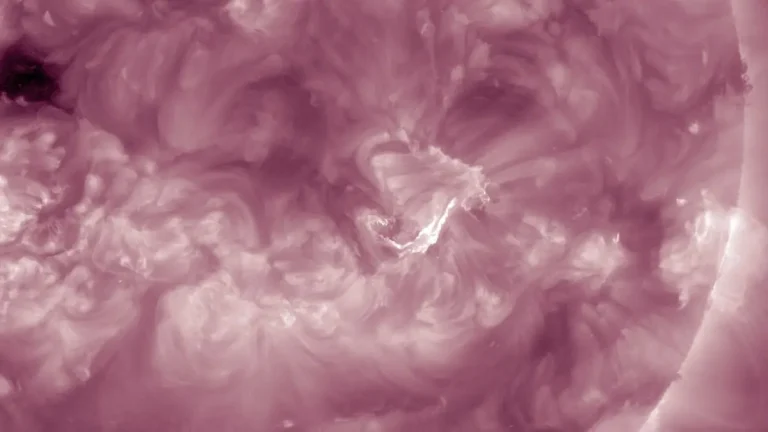
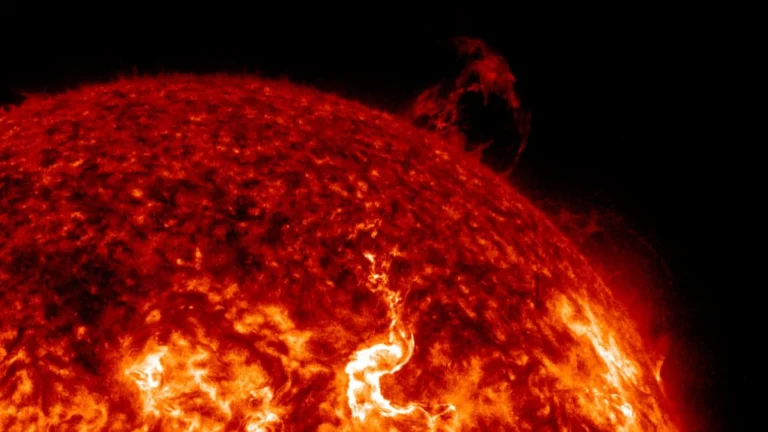
    A filament eruption associated with a C6.1 solar flare from Active Region 4403 at 23:28 UTC on April 1, 2026, produced an asymmetric halo coronal mass ejection. Initial modeling indicates the bulk of the ejecta is directed north of Earth’s orbit, with a possible glancing impact early on April 4 that could trigger minor to moderate geomagnetic storming. Current geomagnetic conditions remain influenced by a combined coronal hole high-speed stream and prior CME activity.
  • Multiple Earth-directed CMEs expected to trigger G1 geomagnetic storm and aurora at high latitudes

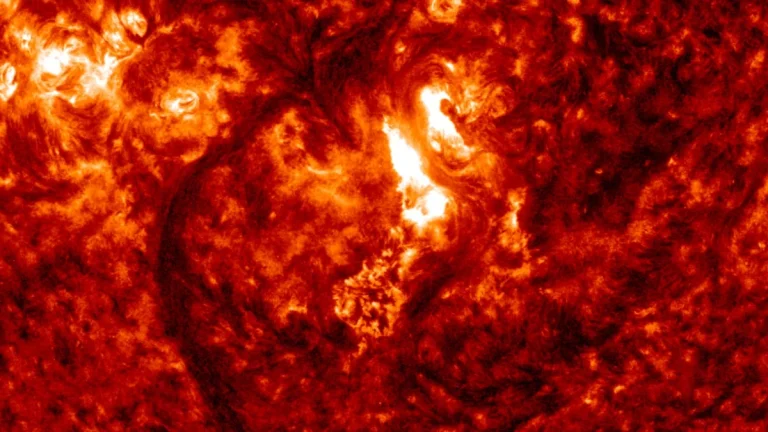
    Multiple coronal mass ejections (CMEs) launched from Active Region 4334 on January 8, 2026, are expected to deliver a glancing blow to Earth between late January 10 and early January 11, according to the U.S. Space Weather Prediction Center (SWPC). The interaction of several CMEs and a coronal hole high-speed stream is forecast to cause isolated G1 – Minor geomagnetic storm conditions. Aurora may become visible across high latitudes, including the northern tier of the United States, such as northern Michigan and Maine.

  • CME impact and high-speed stream forecast to enhance geomagnetic activity through September 8

    A large filament eruption was observed at 19:45 UTC on September 4, 2025, followed by at least three CMEs. Model runs suggest a likely arrival early on September 7. In addition, a recurrent positive polarity coronal hole high-speed stream (CH HSS) activity is expected to enhance solar wind parameters beginning early September 6, with G1 – Minor to G2 – Moderate geomagnetic storm conditions likely through September 8.

  • Multiple filament eruptions and CMEs observed, none Earth-directed

    Four solar filament eruptions between May 6 and 7, 2025, produced fast-moving CMEs, all of which are expected to pass north or south of the Earth without impacting us. G1 – Minor storm conditions are likely on May 9 due to a combination of CH HSS and a possible glancing blow from a CME launched on May 5.

  • CME impacts Earth, sparking G1 geomagnetic storm

    A coronal mass ejection (CME) produced on December 13, 2024, impacted Earth at 05:19 UTC on December 17, sparking G1 – Minor geomagnetic storming. The K-index reached 5 at 08:07 UTC, with effects limited to areas poleward of 60 degrees geomagnetic latitude. Enhanced solar wind conditions, driven by a positive polarity coronal hole high-speed stream (CH HSS), are expected to continue through December 18. Meanwhile, solar activity remains low, with a 30-40% chance of M-class flares and a 5% chance of X-class flares through December 19.

  • Filament eruption produces Earth-directed CME; S1 – Minor solar radiation storm in progres

    Early on Sunday, September 8, 2024 (UTC), a magnetic filament erupted from the Sun’s northwest quadrant (N16W22), releasing an Earth-directed coronal mass ejection (CME). The CME is expected to impact Earth on September 10, potentially triggering a G2 – Moderate geomagnetic storm. Concurrently, heightened activity near the Sun’s west limb has caused a sharp increase in proton levels, resulting in an S1 – Minor solar radiation storm at 08:50 UTC today.