
Asteroid 2017 SX17 to flyby Earth at 0.23 LD on October 2
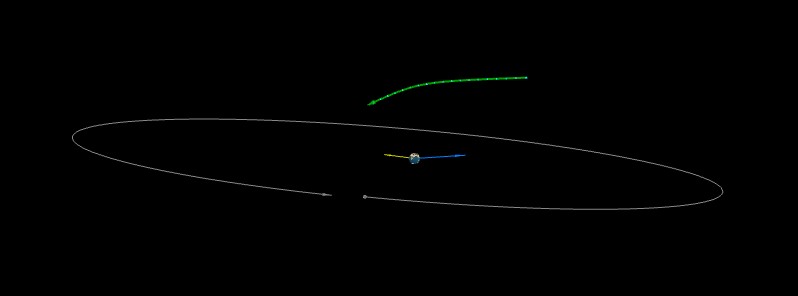
Featured image: The green line indicates the object's apparent motion relative to the Earth, and the bright green marks are the object's location at approximately one-hour intervals. The Moon's orbit is grey. The blue arrow points in the direction of Earth's motion and the yellow arrow points toward the Sun. Credit: Minor Planet Center
A small asteroid designated 2017 SX17 will flyby Earth at a very close distance of 0.23 LD (~ 88 320 km / 54 879 miles) on October 2, 2017. This is the 36th known asteroid to flyby Earth since the start of the year, according to data available at CNEOS on October 30.
Asteroid 2017 SX17 belongs to the Apollo group of asteroids. It was first observed at Mt. Lemmon Survey on September 29, 2017.
The estimated size of this object is between 6.5 and 15 m (21 – 49 feet), according to CNEOS. Minor Planet Center estimated its diameter between 3 and 12 m (9 and 39 feet).
2017 SX17 will make its closest approach to our planet at 10:20 UTC on October 2, 2017 at a speed (relative to the Earth) of 7.31 km/s.
[ Ephemeris | Orbit Diagram | Orbital Elements | Physical Parameters | Close-Approach Data ]
This is the 36th known asteroid to flyby Earth within 1 lunar distance since the start of the year. This is also the 9th such flyby since September 3 and 7th since September 20.
Reference:
Asteroid 2017 SX17 at Minor Planet Center; CNEOS

Teo Blašković founded The Watchers in 2011 and edited it until 2026, covering seismic and volcanic activity, extreme weather, space weather and near-Earth objects. Articles on this page are his archive.
Published in the last 24 hours
- The Leonid meteor shower peaks on the night of November 17, exactly 60 years after the 1966 storm, when some observers reported meteors falling at up to 40 a second, though this year’s show should be closer to 15 an hour
- When Arctic air reached South Florida in January 2020, Miami fell to 40°F and the National Weather Service warned residents to watch for cold-stunned iguanas dropping out of the trees Epicenter
- In May 2024, the strongest solar storm in 20 years put northern lights over the southern US, and across the Plains, GPS-guided tractors built to plant within an inch drifted about 10 feet off their rows Epicenter
- In 1943, a flight instructor in Texas flew a two-seat training plane into the eye of a hurricane because he was curious, then landed and took the base weatherman up for a second pass Epicenter
