• Night sky guide for August 2015

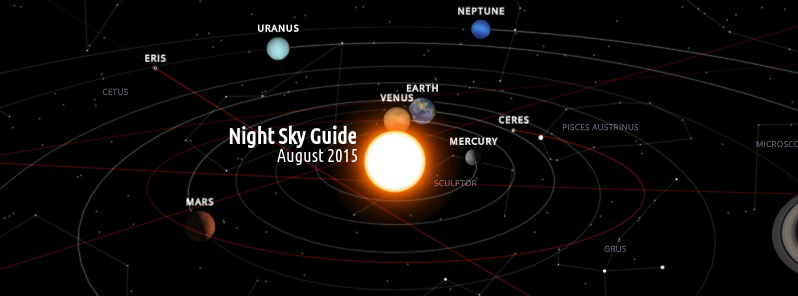
    Every year, sky watchers in northern hemisphere enjoy in one of the best meteor showers of the year – Perseids. This year, Perseids will peak on the night of August 12 and the morning of August 13. This meteor shower is known for its very fast and bright meteors which l

  • Slow moving, very bright fireball turns sky green over Argentina

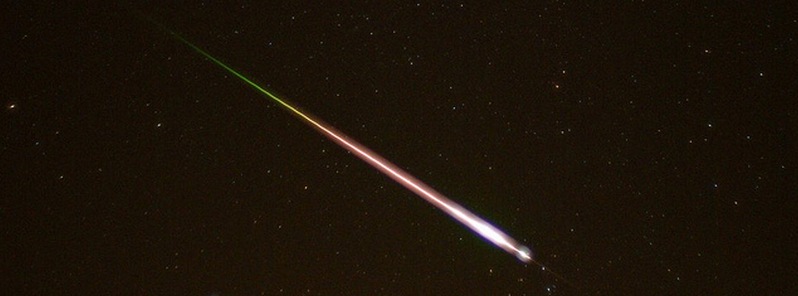
    A slow moving and very bright fireball was observed and recorded over Argentina around midnight UTC on July 31, 2015 (21:00 local time on July 30). Observers say the spectacle lasted about 10 seconds, turning the whole sky green. No sound was associated with the event.

  • Unusual red arcs spotted on the surface of Saturn’s icy moon Tethys

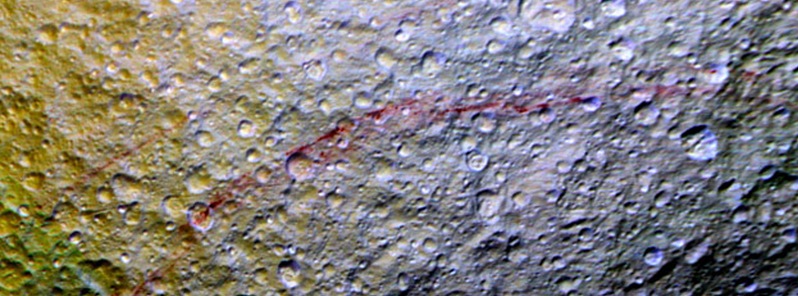
    New enhanced-color images from NASA's Cassini spacecradr revealed unexplained arc-shaped, reddish streaks on the surface of Saturn's icy moon Tethys. The red arcs are narrow, curved lines on the moon's surface, and are among the most unusual color features o

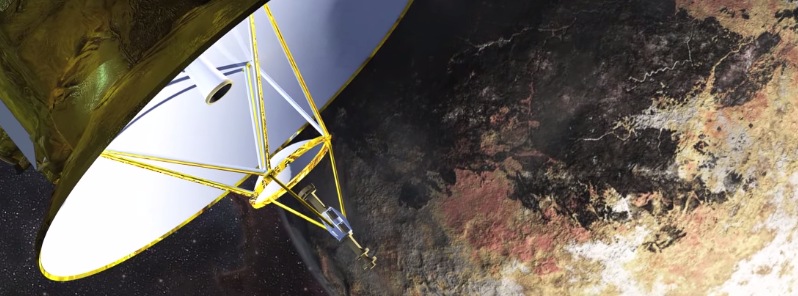
  • Pluto sends planetary scientists back to the drawing board

    Today, physicist Wal Thornhill continues his discussion of NASA’s New Horizons mission to the dwarf planet Pluto. The mission has already provided a number of surprises for planetary scientists.The tiny planet’s geological activity, its apparent age, the stu

  • Blue Moon on July 31, 2015

    For the second time this month, the Moon is about to become full, but it most likely won't turn blue, like it's name suggests. According to modern folklore, whenever there are two full Moons in a calendar month, the second one is "blue." Most Blue Moon

  • New Horizons update: Pluto and planetary origins

    NASA’s New Horizons mission to the dwarf planet Pluto is attracting international attention to planetary science. And like all recent missions to planets, moons, comets and asteroids, surprising discoveries already abound for scientists on Earth. Giant mountains o

  • NASA’s Kepler mission discovers closest Earth twin yet

    NASA made an announcement on July 23, 2015 of it's Kepler space telescope spotting the most Earth-like alien planet yet discovered – a world called Kepler-452b that's just slightly bigger than our own and orbits a sun-like star named Kepler-452 at about the same

  • Mystery of equatorial noise solved

    A team from MIT, the University of California at Los Angeles, the University of Sheffield, and elsewhere has detected a remarkably orderly pattern amid the "equatorial noise." The discovery may help scientists to more accurately model the space environment an