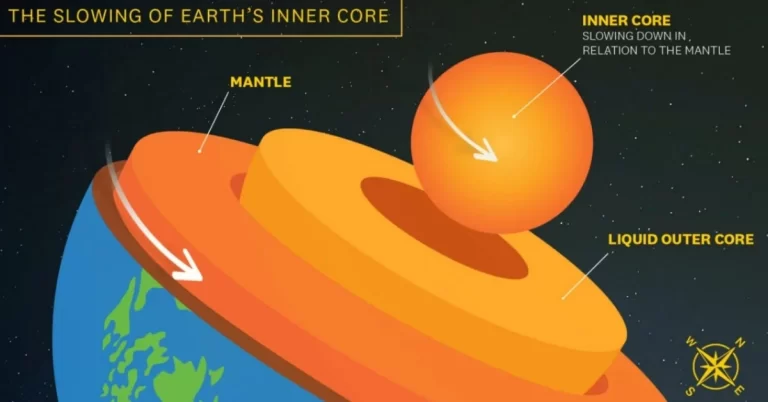
• Earth’s inner core slowdown confirmed by seismic data

    A new scientific study proves that the Earth’s rotation speed has been decreasing throughout the past decade, with data suggesting that the rotational speed of the inner core has gotten 2.5 times slower compared to the past decade.

  • Study suggests ancient interstellar cloud collision shrank heliosphere to 0.22 AU, substantially impacting Earth

    A new study published in Nature Astronomy provides evidence that our solar system passed through a dense interstellar cloud 2 – 3 million years ago, exposing Earth to higher cosmic radiation and altering the climate. The discovery suggests that the Sun’s location in space might shape Earth’s history more than it was previously considered.

  • Egypt sets hottest June day in African history; historic heatwave hits Cyprus

    Aswan in Egypt recorded 50.9 °C (123.6 °F) on June 7, 2024, setting the highest reliable temperature ever recorded in Egypt and the hottest June day in African history. On the same day, Cyprus experienced its hottest June day ever with temperatures hitting 44 °C (111 °F), breaking its record for the second time this month.

  • Mysterious twin of STEVE aurora discovered in Norway

    A new auroral phenomenon, potentially a twin of the STEVE aurora, was discovered in Norway on December 28, 2021. The finding, confirmed by ESA’s Swarm satellite data, reveals an eastward stream of hot gases at dawn, similar to the westward stream seen at dusk.

  • Historic floods, tenfold increase in wildfires and now a potential extreme drought make triple suffering for Brazil

    After historic floods recently claimed 172 lives in coastal Brazil, the country now faces a new crisis as fires rage through the Pantanal wetlands. These fires have surged nearly tenfold compared to the same period last year, setting the stage for a potential catastrophe worse than the devastating fires of 2020. With severe to extreme drought conditions expected, the situation is becoming increasingly dire.