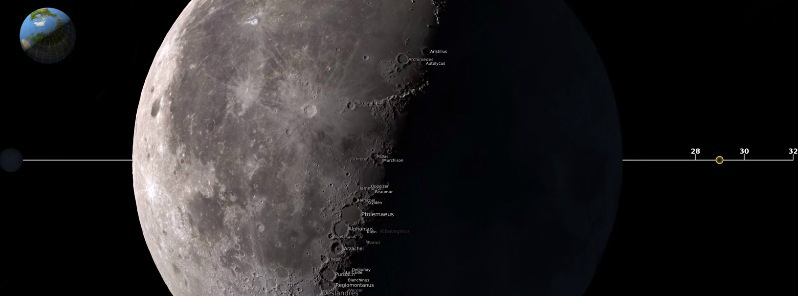
• Moon’s phases and libration at hourly intervals throughout 2016

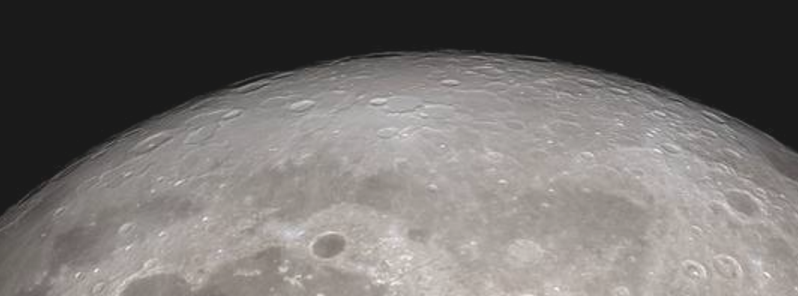
    These visualizations show the Moon's phases and libration at hourly intervals throughout 2016, as viewed from both northern and southern hemispheres. Each frame represents one hour. In addition, the visualizations show the Moon's orbit position, sub-Earth…

  • CME hits Earth, G3 Strong geomagnetic storming expected

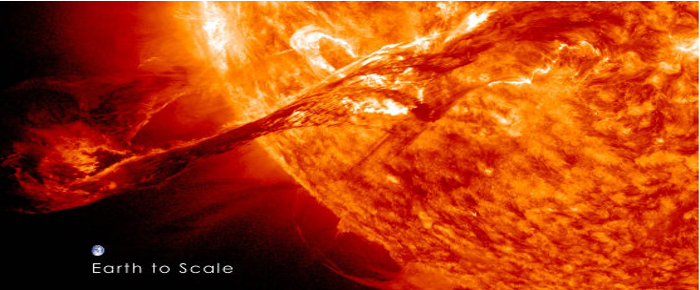
    The December 28th coronal mass ejection (CME) produced by the long duration M1.8 solar flare passed the ACE spacecraft at 00:02 UTC on December 31 and reached our planet at 00:51 UTC. Geomagnetic K-index of 4 threshold was reached at 01:05 UTC. The impact is…

  • Satellite view of massive southwest US storm system

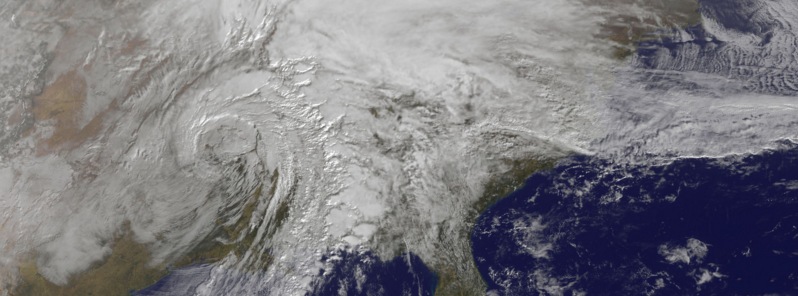
    This animation of NOAA's GOES-East satellite imagery over the course of two days (December 26 – 28) shows a massive low pressure system that generated severe weather in the southwestern and central US bringing snow, heavy rainfall, flooding and tornadoes. During…

  • Using maths to reveal the Sun’s magnetic field mysteries

    An important research project, led by the UK's University of Dundee, aims to improve knowledge of Sun's complex magnetic fields using mathematics. The goal is to find out the effects of space weather caused by the Sun and its magnetic structures origins….

  • Rare full moon to decorate the skies on Christmas Day

    A rare celestial event will take place on December 25, 2015. A bright full moon, although not unusual phenomena per se, rarely coincides with Christmas date and will for sure make a nice contribution to the holiday atmosphere. The full moon of December, the…

  • Lake Poopo on the verge of drying out, Bolivia

    Lake Poopo, the second largest lake in Bolivia, after Titicaca has almost dried up. The event prompted Victor Hugo Vasquez, the Governor of Oruro province to declare a state of natural disaster on December 19, 2015. The lake which used to extend over more than 4 610…

  • Cassini makes final close flyby images of Saturn’s moon Enceladus

    NASA's Cassini spacecraft made its 22nd and the final close flyby of Saturn's moon Enceladus on December 19, 2015 at 17:49 UTC and will now continue to observe the moon from a much greater distance. The spacecraft passed Enceladus at a distance of 4 999 km…

  • Mystery behind ‘auroral breakup’ unlocked

    In a new study published today in the Journal of Geophysical Research, Japanese scientists claim they have solved the mystery of auroral breakups – the formation of auroral substorms and the sudden bursts of brightness. The study overthrows existing theories about…