I'm a dedicated researcher, journalist, and editor at The Watchers. With over 20 years of experience in the media industry, I specialize in hard science news, focusing on extreme weather, seismic and volcanic activity, space weather, and astronomy, including near-Earth objects and planetary defense strategies. You can reach me at teo /at/ watchers.news.

  • Strong explosion at Popocatépetl volcano, Mexico

    A strong explosion occurred at Mexico's Popocatépetl volcano at 01:31 UTC on April 4, 2016 (20:31 local time on April 3). The volcano, also known as the smoking mountain, is located 70 km (43 miles) SE of Mexico City and is known for its frequent…

  • Heavy hail storm damaged 1 000 houses in northern Vietnam

    According to Thanhnien News, an 8-minute hail storm damaged around 1 000 houses and 100 hectares of vegetable fields in Vietnam's Tuyen Quang province on Sunday, April 3, 2016. Witnesses say many hailstones were 10 to 15 cm (3.9 to 5.9 inches) in diameter. The…

  • Ash emissions from Etna’s Northeast Crater, Italy

    Intermittent weak to moderate ash emissions are being observed at Northeast Crater of Italy's Mount Etna over the last couple of days. Weak incandescence can be observed at night, but current events show no signs that could indicate fresh lava. Surface…

  • Recurrent CH HSS causing geomagnetic storming on Earth

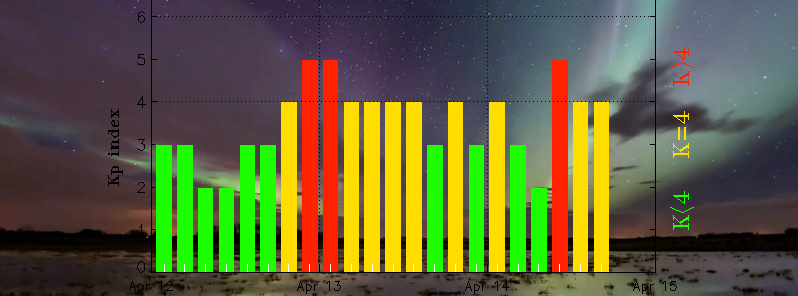
    Our planet is passing through a stream of fast-moving, negative polarity solar wind. Geomagnetic storming reached G1 – Minor levels at 17:24 UTC. A G2 – Moderate warning is in effect for the rest of the UTC day. This is a recurrent CH HSS, responsible for G3 -…

  • Shallow M6.0 earthquake hit Alaska Peninsula

    A shallow earthquake registered by the USGS as M6.0 hit Alaska Peninsula at 05:50 UTC on April 2, 2016. The agency is reporting a depth of 7.6 km (4.7 miles). The epicenter was located 105 km (65 miles) NNE of Chignik Lake, 649 km (403 miles) SW of Anchorage and 683…

  • Night sky guide for April 2016

    April hosts two meteor showers, but only one major. The first – Virginid meteor shower – will reach its maximum rate of activity on April 12. The Moon will be 5 days old and will present minimal interference. The maximum rate of meteors expected to be visible from a…